


The Daily Drive is a reader supported newsletter. For about $1 a week, your paid subscription can help sustain our full-time coverage of golf.
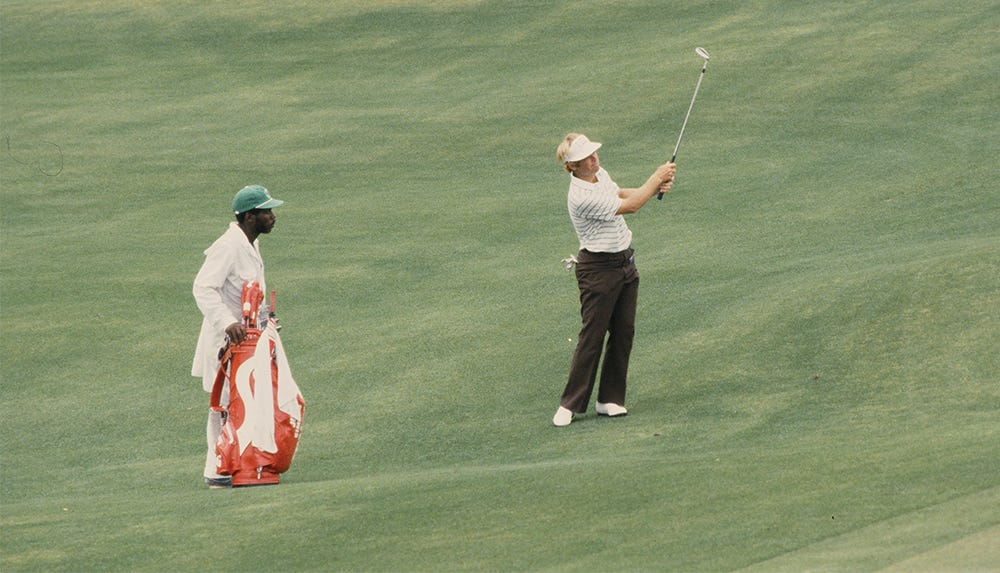
Jim Simons with a local Augusta National caddie at the 1980 Masters (Augusta National/Getty Images)
A caddie is expected to “show up, keep up and shut up” — an old cliché that retains some merit to a degree but isn’t going to be enough in today’s world of big-time golf. where much more than that is expected at the highest level.
From simply carrying the bag to becoming part data analyst, part sports psychologist, part swing coach, the role of a caddie has evolved considerably in the last 50 years.
Gone are the days where caddies packed into cars and drove from site to site, sleeping four to a room and counting their pennies while wondering if they could make it to the next tournament.
That certainly doesn’t exist at a tournament such as the BMW Championship, where $20 million is at stake for the players and a hefty payday is in store for every caddie in the field.
Also in today’s DD …
Did Sergio Garcia’s Masters tee tantrum scuttle LIV Golf?
Shout out to James Colgan’s feature on Old Barnwell’s Evans Scholarship recipient
A passing of Tiger’s career money torch is pending
Today, some caddies carry a level of celebrity themselves. Stevie Williams and Jim “Bones” Mackay were well known in their days working for Tiger Woods and Phil Mickelson, respectively. Ted Scott, who works for Scottie Scheffler, and Michael Greller, the longtime caddie for Jordan Spieth, are other big names in the caddie game.
Gone are the days when a local caddie might get a bag at a PGA Tour event or when players were far more apt to pick up someone along the way then employ a caddie on a near full-time basis.
And even after the era of professional caddies began to evolve, there were a couple of holdouts to the old ways. The Masters and the Western Open used to require that players use local caddies, prohibiting them from bringing their own caddie. It wasn’t until 1983 when Augusta National and the Western Golf Association finally yielded to the players’ pleas to use their own bagmen.
The BMW, formerly known as the Western Open, dates to 1899, when it quickly took up an important place in the golf landscape. That first year saw a couple of Scotsmen duel in a playoff, with Willie Smith defeating Laurie Auchterlonie.
Through the years, the Western Open’s fortunes rose as the game moved around the country. Chick Evans, the namesake of the Evans Scholars Foundation, won the Western in 1910, when it was played as a match play event. For a time, in the years prior to the emergence of the Masters, it was even viewed as a major.
Starting in 1962, the tournament became anchored in the Chicago area, a nod to the WGA’s roots and an understandable move given the great courses it could move to including Medinah, Beverly and Olympia Fields, to name just a few. For more than 40 years, the tournament never left the area.
And for years, the Western Open shared that unique distinction with only the Masters: it required players to use local caddies instead of those who had full-time jobs working for the pros.
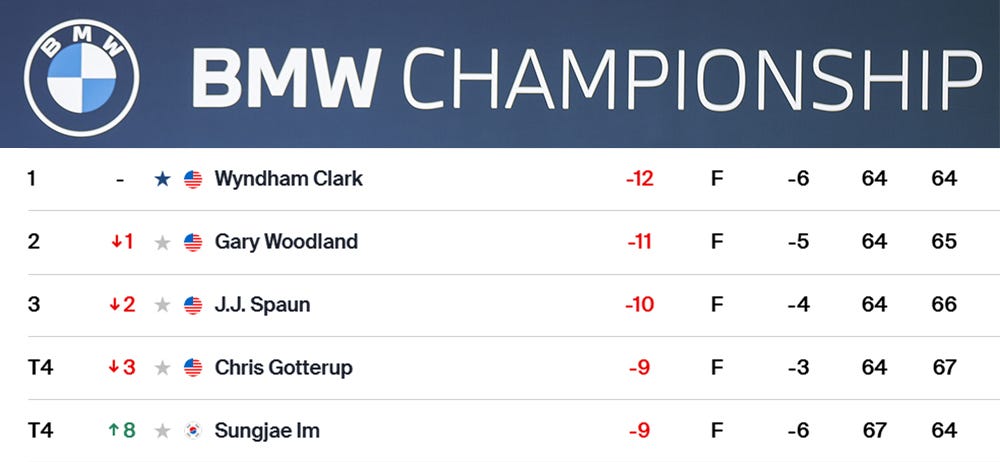
Click here for full BMW Championship leaderboard
At the risk of dating myself considerably, I was one of the fortunate ones who got to take part in that caddie experience. The year was 1980, the Western Open was at Butler National in suburban Oak Brook, Ill. Somehow I was chosen along with a longtime friend (and future Evans Scholar at Indiana University like myself) Mark Riley from the Inverness Golf Club in Inverness, Ill., where we both caddied as teenagers.
In those days, PGA Tour events still had robust Monday qualifying on site (players who did so were called rabbits) and I drew the name of Marty Fleckman, whose claim to fame was leading the 1967 U.S. Open (won by Jack Nicklaus) through 54 holes as an amateur.
Fleckman failed to advance out of Monday qualifying to the tournament, but I did. A few days earlier, in bleachers behind Butler’s ninth green, some 100-plus caddies gathered to have their names drawn, allowing them to then pick a player of their choosing.
Among those in the field that week were Tom Watson, Ben Crenshaw, Tom Kite, Tom Weiskopf, Curtis Strange and Hubert Green. When my name was called — probably 40-some kids into the process — I picked Jim Simons, who had finished among the top 10 a year earlier and was a three-time PGA Tour winner, including the 1978 Memorial. Simons also had an amateur brush with the U.S. Open: in 1971, he led through 54 holes at Merion, where Lee Trevino would ultimately defeat Nicklaus in a playoff.
(Simons was also among the first players to use a metal wood along with Ron Streck. In 1982, Simons won at Pebble Beach, becoming the first player to win a televised 72-hole tournament with such a club.)
Simons got himself into contention in the Western with rounds of 73-69 and we drew a third-round tee time with Andy Bean and John Cook, a rookie out of Ohio State at the time. Simons would eventually tie for ninth while Scott Simpson captured his first PGA Tour victory.
Somewhere remains a photo of the check Simons wrote for my six days of caddying — $450. He made just more than $9,000 for the week and my cut seemed like a fortune.
Several years later, when I had moved on to my sports writing career, I ran into Simons at a tournament I was covering. It took a little prodding, but he remembered having this young kid on his bag all that time earlier. He could not have been nicer. (Sadly, Simons passed away at age 55 in 2005.)
Things change, and the move to having professional caddies full time was already in play. Given the money at stake, and the seriousness of the job, it is completely understandable. To think about how naïve I was to the intricacies of the game then makes me nervous all these years later.
But that experience is my ultimate tie to the tournament, a memory to last a lifetime. As a Chicago kid, I was sad when the event started to move around the country. But what a move that has turned out to be for the Evans Scholars program and the WGA. BMW’s sponsorship has enhanced the tournament as a FedEx Cup playoff event and having it at a place such as Bellerive this week is a home run for golf fans in Missouri and for the Western Golf Association.
The tournament has evolved. But it’s always embraced its history, with more being made every year.
A version of this story appeared on the WGA website celebrating the 125th anniversary or the organization in 2024.
Another Evans Scholar dream come true
Golf’s James Colgan went to Old Barnwell in Aiken County, South Carolina, and wrote a lovely story about Daniella Penaloza, a remarkable 17-year-old caddie at the club who earned an Evans Scholarship to attend the University of South Carolina. The video above does a great job on encapsulating Penaloza’s story.
Did Sergio’s Masters tee tantrum scuttle LIV Golf?
The Financial Times on Friday published a lengthy story titled “The Battle over Golf’s Future” in which it summarized the last several years, including the PGA Tour’s move to a for-profit model called PGA Tour Enterprises, the investment of $1.5 billion from the Strategic Sports Group, and the hiring of Brian Rolapp as CEO and future commissioner.
Along the way, the story highlights the back and forth between the PGA Tour and LIV Golf — it said negotiations broke down early last year because of the tour’s offer to run LIV for between $500 million and $700 million was viewed as too low by Yasir Al-Rumayyan, the governor of the Public Investment Fund which had already poured some $4 billion into the league at that point.
The PIF decided in April to pull its funding from LIV after this year and Al-Rumayyan stepped down from his position as chairman on LIV’s board. The decision has led to considerable upheaval as LIV attempts to secure funding and streamline its business in order emerge next year as a smaller, less lucrative version of itself.
One anecdote the Financial Times highlighted is interesting, if not highly dubious. It centered around the incident during the final round of the 2026 Masters when LIV’s Sergo Garcia was given a warning by a rules official for his outburst on the second tee, where he slammed his club into the turf and broke it while whacking it against a trash bin.
According to the FT: “People familiar with the matter say Al-Rumayyan’s embarrassment at the sequence of events helped lead to his decision to pull the plug on PIF’s financing of the rival tour, as the fund focuses more on its huge domestic commitments in the kingdom.”
Call us skeptical on that even if the timing of PIF’s retreat happened almost immediately after the Masters. While Al-Rumayyan may not have liked what he saw from Garcia, it’s hard to believe he would find that, of all things, embarrassing given the lavish excess he might otherwise now feel sheepish about.
By the Sunday of the Masters, the decision was clearly in the works to end the financing. Two days later is when word began to spread that the Mexico City event that week was in doubt. While it played on amid much scrutiny, the PIF soon afterward announced that it will pulling out due to myriad factors.
A word from our sponsor …
This this week’s Daily Drive newsletter is being brought to you by the Western Golf Association and the Evans Scholars Foundation, which has been sending caddies to college since 1930.
The WGA, which was founded in 1899, sponsors among its events the BMW Championship, which is being played this week at Bellerive Country Club near St. Louis. The proceeds from the tournament benefit the foundation, which currently supports 1,310 students attending 28 universities.
A passing of the career money title is on tap
With his victory at last week’s FedEx St. Jude Championship, Scottie Scheffler pulled within $1,034,475 of Tiger Woods for No. 1 on the all-time PGA Tour money list.
There are a couple of ways to view this.
It is amazing to think that Scheffler has amassed almost $120 million in career earnings so quickly. He just turned 30 years old and first joined the PGA Tour for the 2019-20 season when there was still a wraparound schedule.
It is also amazing to think that in the era of escalating signature-event and major purses that nobody caught Woods sooner. The 15-time major winner who won 82 times on the PGA Tour has not added a dime to his total of $120,999,166 since the 2024 Masters, where he finished 60th and earned $44,400.
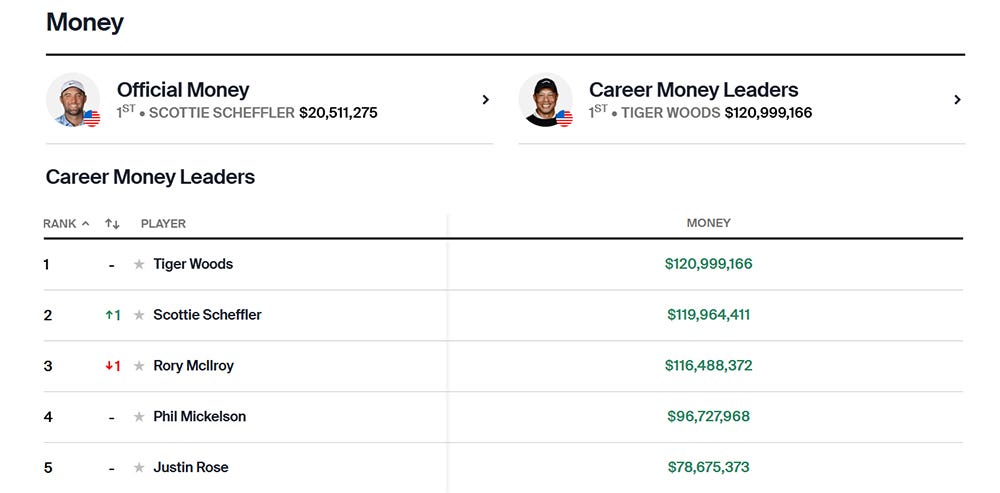
Woods first took over the carer money lead in 2000 — 26 years ago! — when he finished second at Torrey Pines after winning at Kapalua and Pebble Beach earlier that year. He passed Davis Love III, who held the top spot for two whole weeks after passing Greg Norman. At the time, Woods had made $12,821,129.
In 2007, Woods surpassed $50 million and reached $100 million in 2013. Only Scheffler and Rory McIlroy have surpassed $100 million since then. McIlroy has earned $116,964,411. Phil Mickelson, who has not played a PGA Tour event since 2022, has earned more than $94 million in official career money. It’s also notable that Mickelson NEVER won a single-season money title on the PGA Tour.
Scheffler can pass Woods this week in the $20 million BMW Championship if he wins, finishes in a seven-way tie for second or in a three-way tie for third. He’s all but assured to do it in the next two weeks since the Tour Championship is now official money with a $40 million purse.
It’s worth noting that official earnings do not count the nearly $50 million in FedEx Cup bonus money Scheffler has claimed through the years.
“Tiger did a lot for the game of golf and he put us in a position where we’re able to earn some pretty good stuff financially, so that’s something we’re very grateful for,” said Scheffler this week, noting that he’s just over one-fourth of the way with 21 wins to Woods’ record-tying total of 82. “Tiger’s contributions to the game, when you look at where the purses were at before he came out on tour to where they’re at now is a pretty stark difference and we’re very thankful for his contributions to the game and hopefully we’ll see him back out here competing again soon.”
Even if Tiger gets back to competing, sage to say he’ll never reclaim his money crown.
Mike "Fluff" Cowan was asked once what made for a great caddie?. His answer: "A great player."
A trip down memory lane my friend. I often have the same anxious thoughts about how little I knew about the game. Gary Hallberg didn’t fare as well as The Lizard with Harig on the bag. Thanks for the honorable mention.