


The Daily Drive will have coverage of the U.S. Open from veteran golf insider Bob Harig all week from Shinnecock Hills.
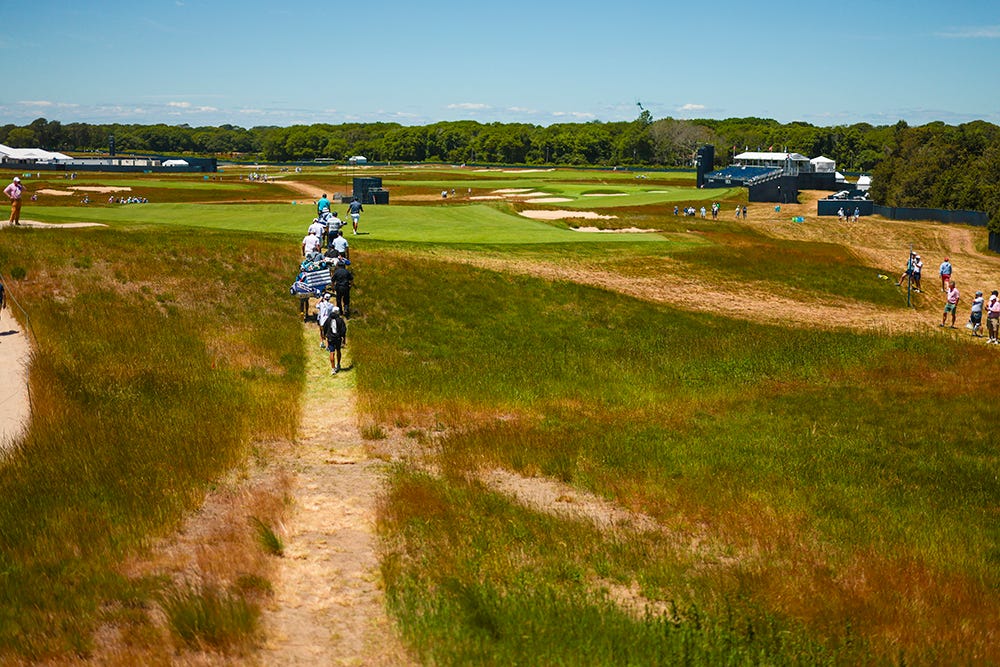
Defending champion J.J. Spahn walks down the 15th hole at Shinnecock (Kathryn Riley/USGA)
In today’s DD …
Another Daily Drive podcast with Bob Harig and Jason Powers
USGA’s effort to maintain control this time around at Shinnecock
Alex Miceli: Is Scottie Scheffler the unbeatable man?
Stray Shots by Peter Kaufman
U.S. Open broadcast schedule
Shinnecock Hills flyover look at every hole
The Daily Drive is a reader-supported publication. To receive new posts and support our work, consider becoming a free or paid subscriber.

Bob Harig and Jason Powers discuss …
U.S. Open history at Shinnecock
Scouting report of the course
Caddies role in scouting the course early in the week
Is Brooks Koepka’s injury going to keep him out of the U.S. Open?
Players to keep an eye on for top 10/20 or victory
Adam Scott’s incredible level of major consistency ,,, and more
Mickelson’s misguided protest made a point
By Bob Harig
SOUTHAMPTON, N.Y. — Phil Mickelson was wrong to do what he did. He was wrong to play hockey stick with his putter on the 13th green during the third round of the 2018 U.S. Open. He was wrong to make the point he controversially wanted to get across in that manner.
Mickelson’s message might have had considerable merit but his delivery overshadowed what occurred at Shinnecock Hills that day eight years ago. In the end, perhaps like numerous examples with Mickelson over the years, he had a point even if his methods were not appropriate.
The six-time major winner is not here this week as the U.S. Open returns to Shinnecock Hills, but the memories he created here remain. From a frustrating Saturday round in 2018 that quite possibly led to an overreaction the final day by USGA officials to the memories of 14 years earlier, when the historic course got out of hand during the final round when Mickelson finished runner-up
Will it happen again at one of the U.S. Open pillar venues?
The USGA’s desire to test the best players in the world to the extreme has always been met with scrutiny as it tries to balance presenting a fair test with setting up an extremely difficult course. The storyline, at times, has overshadowed the players.
Even last year at Oakmont, where J.J. Spaun saved the day with a remarkable birdie putt on the final green, there was considerable conjecture about the wetness of the course after a lengthy rain delay on Sunday led to some difficult conditions over the final nine.
That last time at Shinnecock, Zach Johnson didn’t do anything silly during his third round eight years ago, but he did offer a blunt assessment afterward when asked if the course was on the edge.
“No, we’re not on the edge,” Johnson said. “I thought we could be on the edge, but we’ve surpassed it. Unfortunately, they’ve lost the golf course.”
Similar comments from others followed.
Mickelson’s antics, while widely panned, were also an indication of how the course became a problem.
When he saw his bogey putt slide low of the hole and begin to trickle down the slope heading off the green, he ran after the ball, hit it again before it stopped, stroking the ball past the hole.
From there, he two-putted, and was assessed a two-stroke penalty for hitting a moving ball, leading to a score of 10 on the par-4 hole and a round of 81.
As he walked off the green, he shared a laugh with playing partner Andrew “Beef” Johnston. Many, including USGA officials, did not find it funny.
“I don’t mean it disrespectful; if you’re taking it that way, that’s not on me,’’ Mickelson told reporters after the round. “I’m sorry that you’re taking it that way, it’s certainly not meant that way. Sometimes in these situations, it’s just easier to take the two shots and move on.’’
Truth is, what Mickelson did was disrespectful. But it delivered a strong message. The USGA had let the greens get out of hand at Shinnecock again and the players weren’t having it.
“It’s been unfortunate what’s happened. I’ve got great expectations that we are going to have a great week. I’m trying not to be a cynical old pro.”
Adam Scott
Mickelson was also a part of the plot at the 2004 U.S. Open at Shinnecock, coming off his first major championship victory that year at the Masters. He finished two shots behind winner Retief Goosen after three-putting the 71st hole from 5 feet for a double bogey.
But the main controversy centered around the par-3 seventh hole — Redan — that last day. The green had become so firm that early shots during the final round were rolling off at an alarming rate. Jim “Bones” Mackay, Mickelson’s caddie, said last week during an NBC conference call in advance of the U.S. Open that he advised Mickelson to aim for the bunker left of the green. He reasoned it was the only way the golfer could come close to making a par — which is exactly what he did.
Hall of Fame golfer Johnny Miller, then the NBC lead analyst, had scouted the course in the morning and knew that something was amiss.
“I remember it very clearly,” said Dan Hicks, the NBC-TV lead announcer then and now. “Johnny completed his little trek around the golf course where he’s looking at the hole locations and just checking things out, and he comes up to the tower, and he’s just unusually out of breath and excited as if he just saw something that he can’t believe he saw.
“So, I’m like, ‘what’s going on?’ He says, ‘you’re not going to believe this … they’re going to have to stop the U.S. Open.’ And David Fay was in the tower with us, because at the time he was our rules guy in there with us as the executive director of the USGA. And his radio starts crackling, and it’s all becoming this scene of like, ‘Oh, my God, this is crazy.’ I don’t know if anybody’s ever seen anything like this, heard anything like that.
“So, David’s radio is crackling, and he’s going, ‘What’s going on over there at the seventh hole?’ So, then Johnny proceeds to say, ‘I watched the first three groups go through and there’s no way they can keep it on the green.’ And he was absolutely convinced that they were going to have to stop the U.S. Open. So they ended up stopping play. They ended up syringing the greens (with water).
“I’ll never forget it. Kevin Stadler was one of those players that went through there, and Johnny goes, ‘he hit the most perfect shot and it wouldn’t stay on.’ So, we come on the air, it was very chaotic because we had to deal with something that was wild.”
Only 11 players shot par or better over the final two rounds in 2004. The low score on Sunday was Robert Allenby’s even-par 70.
After his final round, Tiger Woods said “they lost control of the golf course.
“There’s nothing wrong with a guy being under par; there’s nothing wrong with that,” Woods added. “If they play well, they deserve to be under par, but not like this; this is not the way it’s supposed to be played.”
Despite assurances that it wouldn’t happen again when the U.S. Open returned in 2018, well … it did. Brooks Koepka won with a final-round 68, edging Tommy Fleetwood by a shot after the Englishman rallied with a 63 on the final day having completed the first 54 holes at 8-over par.
All that backstory leads to this week and the tepid confidence that history will be a guide, that lessons were learned and that Shinnecock Hills will shine for the reasons that make it one of America’s greatest courses.
“It’s been unfortunate what’s happened,” said Adam Scott. “I’ve got great expectations that we are going to have a great week. I’m trying not to be a cynical old pro.”
U.S. Open TV schedule

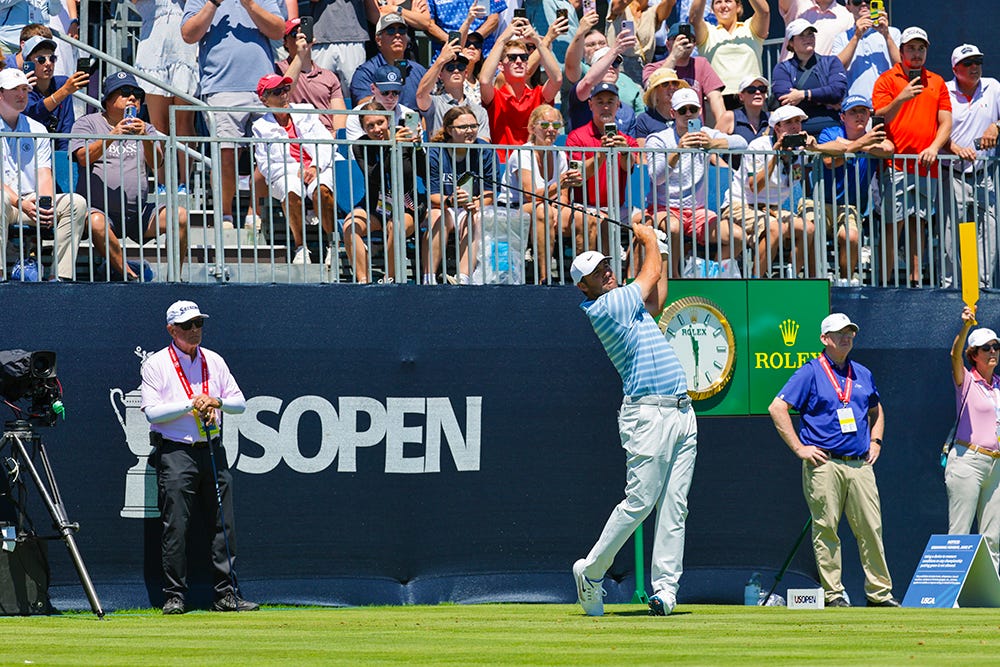
Scottie Scheffler tees off the 10th in a practice round at Shinnecock (Jeff Haynes/USGA)
The curious discourse on Scottie’s vincibility
By Alex Miceli
Is Scottie Scheffler no longer the man that can’t be beat?
That is (sort of) the assessment made by Golf Channel analyst Brandel Chamblee last week on a conference call with the media.
First off, even in his heyday, neither Jack Nicklaus nor Tiger Woods were ever the men that couldn’t be beat. Favorites, yes; unbeatable, no. Golf doesn’t offer sure things.
Oddly — despite calling the world No. 1’s game “off” — the longtime analyst still called Scheffler the man to beat.
Which makes Chamblee’s whole analysis a little perplexing.
