


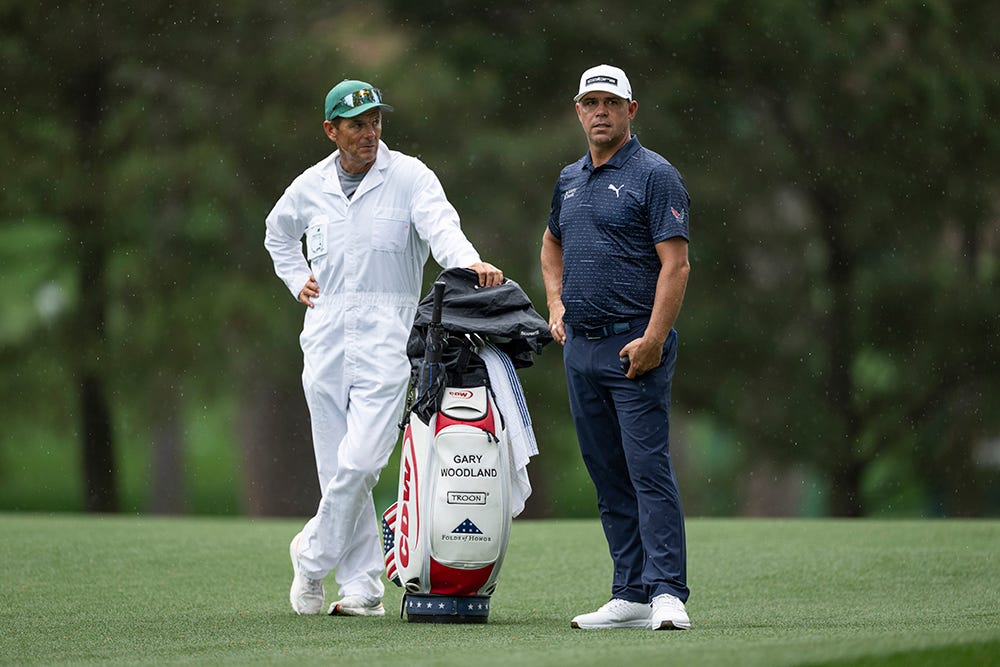
Gary Woodland and caddie, Brendan Little, enjoying some peace on 17th fairway (Chris Condon/Augusta National)
AUGUSTA, Ga. — The minute Gary Woodland promises not to get emotional, buckle up.
Woodland couldn’t help himself Tuesday. In the interview room for the first time in years at Augusta National, the recent Houston Open winner couldn’t contain his emotions when discussing his return to the Masters.
The 2019 U.S. Open champion at Pebble Beach — who had surgery in 2023 to remove a benign brain tumor — acknowledged before the Players Championship last month that he suffers with PTSD and has been especially anxious about his surroundings.

That’s no easy task to handle for a professional golfer surrounded by galleries at every tournament he plays. Even under the best of circumstances, anxiety is tough to control. He needed to do just that two weeks ago at Memorial Park in Houston en route to his first victory in seven years.
“I had a big battle Friday of Houston,” Woodland said. “I got hypervigilant on the ninth hole, and I battled the last 10 holes thinking people were trying to kill me. I have security with me. The tour’s been amazing.
“But I talked to tour security that night and I told them what I was going through, and every time I looked up on the weekend, my security team was behind me. Last year I didn’t talk to tour security. I fought this on my own. It was awful. Turning around and knowing that I’m safe, having somebody there with me, it’s the only reason why I won two weeks ago.”
The Texas Childrens’ Houston Open victory, his fourth on the PGA Tour, earned him the final spot into the Masters field after missing out last year. Woodland had been exempt through 2024 due to his 2019 major win, but that pass had expired.
In the aftermath of his brain surgery, it was remarkable enough that Woodland returned to golf at all, even if his game did not always meet his usual standards. Winning seemed a long way off if at all, and with it the likelihood of qualifying again for the Masters.
“I’m emotional from the standpoint I know how close I probably was to never being back here, and I’m very proud of myself for earning my way back,” Woodland said.
“I’m in a different spot than I’ve been in a long time. Coming back in ’24, I was still fresh from surgery. I just didn’t know what the future held. Now I know the fight I’m in.
“I’m not going to get emotional, but I know what I’m battling every day. People ask me how was the win? The one thing I know is having this brain tumor and having PTSD, it doesn’t matter if I win or lose. It doesn’t care. I had a tough time last week battling this stuff. A lot of stimulation comes with winning, stuff I hadn’t seen in a long time.
“It’s a big week for me this week. The fans are very close on the tee boxes. There’s a lot going on. There’s probably not a safer golf tournament in the world, so I’m happy for that, but it’s still a battle in my head if I’m safe or not. That’s a tough pill to swallow.”
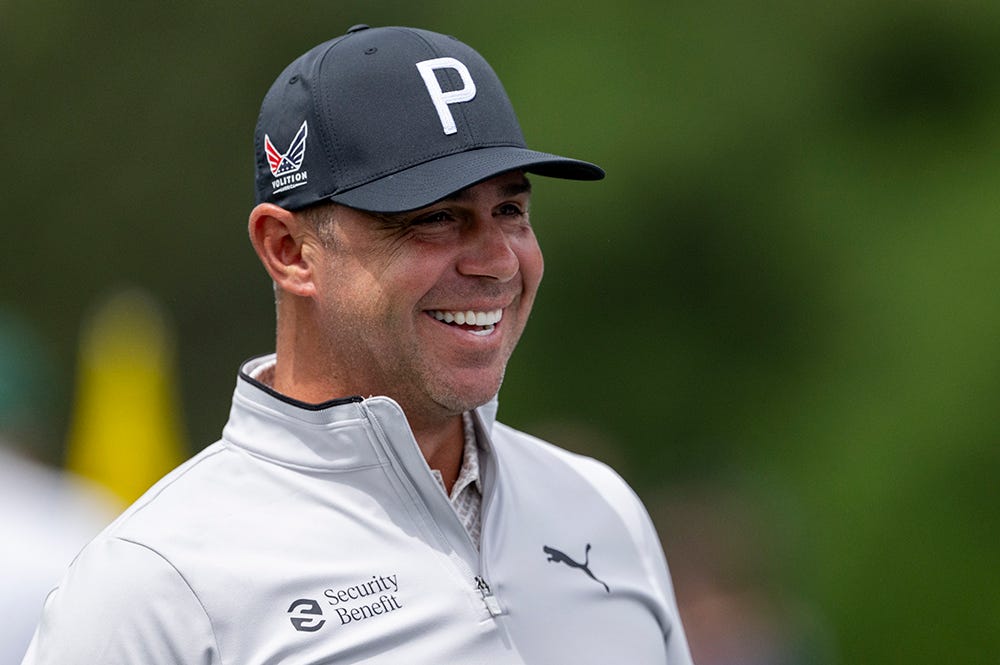
Gary Woodland fights his PTSD every day on the golf course. (David Paul Morris/Augusta National)
Woodland said he has issues with people being too close to him, which is a product of his PTSD. Thus he feels a sense of calm when he notices security personnel that he knows — or whom his caddie, Brendan Little, points out during a round.
Woodland consulted with PGA Tour personnel as well as Augusta National officials to help provide some level of comfort this week. It helps that at Augusta National, there are fewer people inside the ropes — players, caddies and rules officials only.
“It’s given me purpose, golf has, for sure,” Woodland said. “When I was diagnosed with this brain tumor three years ago, my number one thought was I wasn’t going to let this thing win. I’ve dreamed of being a professional athlete since I was a little kid, and I would do everything in my power to live that dream for my childhood self.
“Golf has given me something a lot more to fight for than just myself and my family. I love being out here. I love the guys. I love competing. And the thought of losing that is hard.
“There’s been times where I wondered if I was going to be able to do it, but I was going to fight and give it everything I had. There’s definitely times, even this year, where physically I think my game is as complete as it’s ever been. I think it’s more complete than when I won in ’19 at the U.S. Open. But there’s been times where I didn’t know if I’d have the mental stamina to get through a week.
“I fought hard earlier this year with some struggles, and that’s hard. That’s a hard pill to swallow that this thing could be taken away from me for something that’s out of my control.
“Houston was a big step in the right direction, just from a confidence standpoint, that even with hard days, I can still compete.”
Woodland will play in one of the marquee Masters pairings on Thursday and Friday, going out late in the first round with world No. 1 Scottie Scheffler and Scotland’s Robert MacIntyre.