


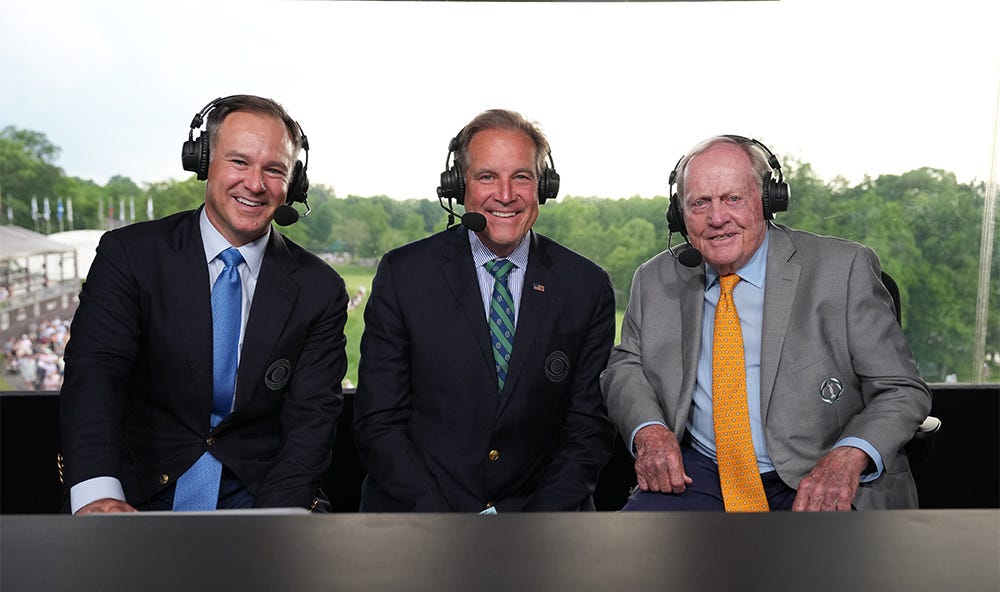
Jack Nicklaus stopped by CBS booth during Memorial broadcast (Ben Jared/PGA Tour via Getty Images)
Jack Nicklaus met for the first time with PGA Tour CEO Brian Rolapp last week at Muirfield Village and it would have been great to be a fly on the wall listening in on that conversation. Although it was undoubtedly cordial, you can bet there were some uncomfortable moments, too.
At this point in time, the 86-year-old Golden Bear has no you-know-whats left to give.
In his pre-tournament news conference on Tuesday at the Memorial Tournament, Nicklaus said he didn’t want to comment on the proposed new PGA Tour schedule. He commented anyway, expressing his concerns about the two-tiered model while also pointing out how some events — such as the Cognizant Classic that he is involved with at PGA National in Florida — are severely impacted by the crowded schedule.
“I hate to see tournaments bunched too much together with too many big tournaments too close together,” Nicklaus said. “That’s a problem, I think. And I think that’s going to be a problem for the tour in the future.”
Nicklaus presided over the 51st playing of the Memorial, a tournament he founded in 1976 when few other events outside of the major championships stood out like his event in Ohio.
Now it is one of nine tournaments with $20 million purses, not including the Players Championship and the Tour Championship. The plan is to have even more of them. Nicklaus is understandably looking out for an event he’s taken a half century to craft, one that used to be the PGA Tour’s crown jewel between the Masters and U.S. Open.
Rolapp met with reporters last week at the Memorial to explain some of the ideas being considered — changes he is likely to announce in more detail in two weeks at the Travelers Championship after the next Policy Board meeting. The Track 1/Track 2 system would actually add more big events and likely have 120- to 130-player fields in Track 1 events. But it isn’t likely to see players competing in both tracks.
“I think what we have found as we’ve talked to sponsors both for Track 1 and Track 2, there’s a lot of demand for both,” Rolapp said. “And the price points will be different. The bigger events … not everyone can afford and may not be sort of consistent with their business goals. That’s great. There’s other price points too for it, and I think there’s plenty of demand for both Track 1 and Track 2 in that regard because there’s definitely people who want to invest different amounts in these events.”
That is a long way removed from the PGA Tour that Nicklaus helped found. Back in 1968, Nicklaus — along with Arnold Palmer and Gardner Dickinson — helped form the Tournament Players Division within the PGA of America, with the idea of giving autonomy to the players over tour operations.
This was the players breaking from the PGA of America to become what eventually would be known as the PGA Tour. Some in recent years have likened this to what players who jumped to the LIV Golf league did — although it is really not the same at all.
LIV Golf is a rival league. What Nicklaus was part of was giving tour players a distinction from club pros.
The players would still play the same tournaments on the schedule but would be a separate arm away from the organization of that runs the PGA Championship and the Ryder Cup.
Nicklaus talked to me about this topic for a book I recently had published called Tiger V. Jack: Golf’s Great Debate. He explained how players then were frustrated with a lack of control over tournament schedules and policies, what they felt was in inequitable distribution of revenues. He and others believed the players didn’t have enough say in decisions that were impacting their careers.
“Club pros were in charge of the whole thing and it wasn’t fair,” Nicklaus said. “And we didn’t mind want to harm the PGA of America. When we formed the board, we had PGA of America directors on it. If we couldn’t convince two people that we were right, then we were probably wrong.”
Later that year, a formal agreement was reached which led to the Tournament Players Division within the PGA. It was operationally separate and a commissioner was hired — Joe Dey, a former USGA president.
The name PGA Tour did not occur until 1975 under the direction of Deane Beman, the second commissioner who succeeded Dey in 1974.
“Yeah, it was controversial,” Nicklaus concedes. “Back in those days, when you signed your entry form to play in a tournament, you were signing over your rights to the PGA of America. For endorsements, the whole bit. That didn’t mean you couldn’t probably do it. But they could contest it to let you play.
“We just felt like we wanted to have our own rights. Arnold, Gardner Dickinson and I were on the board. We tried to work it out. The PGA of America didn’t want to work it out. So we headed our own direction.”
When asked about this last week, Nicklaus said the current situation is a “big, big difference” from 60 years ago and that back then “nobody had any vision.”
Two years ago, the Memorial Tournament was moved to the week prior to the U.S. Open, a date that Nicklaus said he agreed to in deference to the PGA Tour but one he didn’t like. A year later, it was back in its traditional spot after Memorial Day, two weeks before the U.S. Open.
Now, Nicklaus simply wonders if there is too much of a good thing and is concerned about where the for-profit tour is going. And you know he let his concerns be known.
“The PGA Tour is probably the healthiest it’s ever been,” Nicklaus said last week. “I think it’s doing well. We’ve got a great group of players. It’s an international game. Tours on the other side of the Atlantic and tours in the Pacific and even in South America, those tours are all helping build and grow the PGA Tour. I don’t have a comment really on the LIV thing because I don’t really know what’s happening — it’s none of my business. But I think the PGA Tour’s really healthy. I’m proud that back in 1968 we were able to start something that’s gotten to this point.”
But now it’s going to another point, one whose destination is far from determined.
That was the backdrop to a busy week of golf:

Superstar Nelly Korda wins her second major of the year at Riviera (Logan Whitton/USGA)
In the U.S. Women’s Open, Nelly Korda captured her fourth major title but first U.S. national championship at Riviera, which was the co-star of the week and made for an excellent tournament. More women’s majors at iconic courses, please. Korda is 40 percent of the way to the calendar slam after winning the Chevron Championship already this year.
At the Memorial, J.T. Poston parred the second playoff hole to beat Ryan Gerard. Poston qualified for both the U.S. Open and Open Championship just by getting into the playoff. He earned the U.S. Open spot by moving into the top 60 in OWGR and got the spot in The Open awarded via the Open Qualifying Series.
At the LIV Golf Andalucía event at Valderrama in Spain, Tyrrell Hatton — a week after skipping the South Korea event to be home for the birth of his first child —won by two strokes over Jon Rahm. It was Hatton’s second LIV victory. Although he missed the cut last month at the PGA Championship, Hatton tied for third at the Masters and tied for fourth at last year’s U.S. Open.
With a tie for 24th at Valderrama, Joaquin Niemann hung on to the third spot in the LIV individual standings which means he earned the league’s spot at the Open next month. Thomas Detry for a time had moved into that position and could have snagged Royal Birkdale spot a runner-up finish. But he ended up tied for fifth after a final-round 74, which also likely cost him a spot in next week’s U.S. Open. Detry is 65th in the OWGR.
At the KLM Open on the DP World Tour, former LIV golfer Eugenio Chacarra won for the second time on the circuit and moved to sixth place in the Race to Dubai standings. The top 10 not otherwise exempt earn a spot next year on the PGA Tour.
Golf’s ‘longest day’ is here
Approximately 65 spots in next week’s U.S. Open at Shinnecock Hills will be available at 10 final qualifying sites Monday — nine venues in the United States and the other in Canada. The number of spots available from each qualifying site will be determined just prior to players teeing off at the various venues, and the number of spots could increase based on USGA projections.
Live scoring from all of the 36-hole qualifiers will be available at usopen.com. Golf Channel will provide 10 hours of coverage: noon-2 p.m. and 4 p.m.-midnight.
The only other qualifying avenues into the field at Shinnecock will be: via the top 60 not otherwise exempt in the Official World Golf Ranking on June 15; a player who wins for the second time on the PGA Tour since last year’s U.S. Open; and via the final qualifier alternate list.
The alternate category is why players who miss out at the various qualifiers today still have something to play for if there is a playoff for alternate spots. Through Sunday, there were 105 players exempt for the U.S. Open, meaning 51 more spots are available. Almost assuredly some will come from the alternate list.
One of the qualifiers is in Ontario, Canada, is in conjunction with this week’s RBC Canadian Open at TPC Toronto. Among those signed up to try to make their way through there are Max Homa, Rasmus Højgaard, Beau Hossler and Garrick Higgo.
At one of two sites in Ohio after the Memorial, 2009 U.S. Open champion Lucas Glover, Brian Cambpell and Davis Thompson are scheduled to tee it up at Lakes Golf & Country Club in Westerville. J.T. Poston was entered but gets to skip now that he will be among the top 60 in the OWGR and qualify that way.
At the Springfield, Ohio, qualifier, Tony Finau, Brandt Snedeker, Billy Horschel, Neal Shipley and Aldrich Potgieter are signed up to play.
Geoff Ogilvy, the 2006 U.S. Open champ, is listed in the field along with Kevin Na, club pro Michael Block and mid-amateur great Stewart Hagestad at Del Paso CC in Sacramento, California.
At Woodmont CC in Rockville, Md., teenager Blades Brown and Michael Thorbjornsen are teeing it up.
At BallenIsles in Palm Beach Gardens, Fla., 17-year-old junior Miles Russell and 47-year-old Matt Kuchar will try to qualify.
More final qualifying storylines are highlighted on the USGA website.
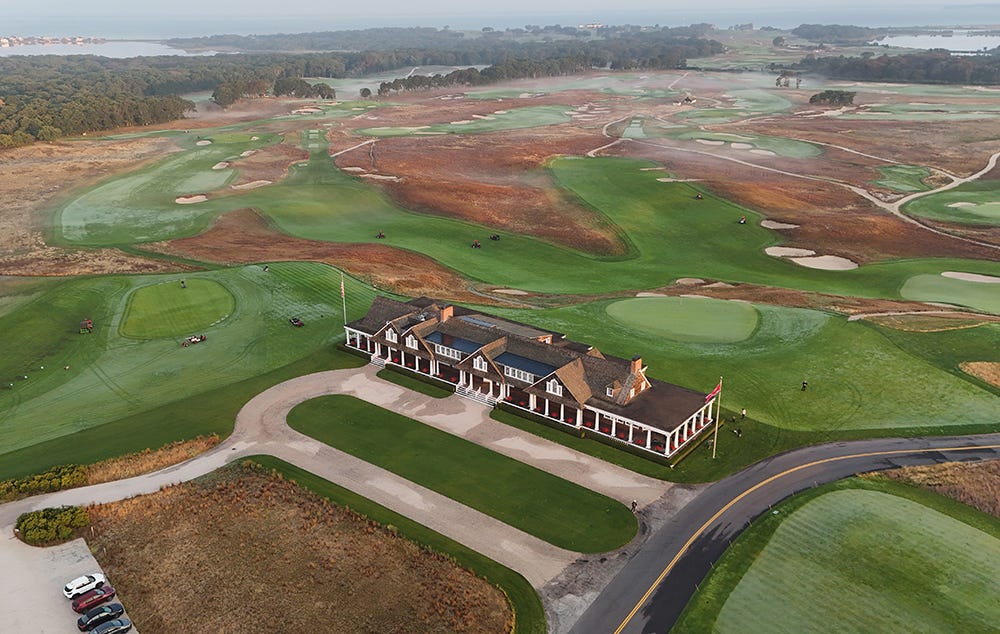
Shinnecock Hills will boast wider fairways than prior U.S. Opens there (Bruce Bennett/Getty Images)
Speaking of Shinnecock …
World No. 1 Scottie Scheffler visited the site of the U.S. Open before going to the Memorial Tournament last week. He’ll be making his first attempt to complete the career grand slam at Shinnecock.
“I hadn’t been there prior,” Scheffler said of the venue that has hosted five previous U.S. Opens, including the second one in 1896. “That was my first time on property. It was kind of what I expected. I had heard some rumors about how difficult the greens were. I was a little surprised at the width of the fairways, but the green complexes there are extremely difficult, and I think that’s where the greatest challenge comes from.
“The rough, also, was a really good penalty, I think, for the width. Once you start missing fairways out there, you have no chance. But the fairways are generous enough to where it provides you some opportunity and that way it’s just that the green complexes are extraordinarily difficult, and so they can put the pins wherever they want and make the scores as high as they could possibly want them to be.”
Rory McIlroy, who missed the cut at Shinnecock the last time the U.S. Open was there in 2018, also visited last week.
“Shinnecock looks good,” McIlroy said. “The fairways are very generous. They’re more generous than they were in 2018. But the first cut of rough is 5 inches long. So it’s like the first cut is maybe three paces wide and then it gets into the fescue. The fairways are very, very generous. So if you miss the fairway, I feel like you deserve a bad lie.
“And the greens are — it’s still quite green. We played on Monday. The greens are rolling around 11, 11.2, something like that. And I really don’t think they need to get much faster. I think if they can keep them at that green speed, they can get them firm, and they can use the hole locations that they want to use without having some of the struggles that they have had the last couple of U.S. Opens.
“So to me, it’s all about them just maintaining the green speeds really where they are and not getting them too out of hand, and I think it will be a great week. If it’s set up the right way, I think it’s one of the best championship tests in the country. I mean, it’s an amazing golf course.”
So now you tell us
Cam Smith had some interesting comments last week in Spain prior to LIV Golf’s event at Valderrama, saying that the massive prize fund structure for the league is not working.
Yeah, and persimmon woods are probably a thing of the past, too.
Smith wasn’t saying anything that isn’t already obvious, but it was interesting to see it come from the 2022 Open champion who bolted for LIV Golf later that year, signed for a $100 million plus bonus and has raked in more than $30 million in individual prize money, not including what he’s gotten from the team payouts and an $8 million bonus he received as part of the individual points race in 2023.
All of which makes it a bit humorous that Smith wouldn’t have a problem with LIV Golf readjusting its purse structure downward in order to play on beyond this year as the Public Investment Fund will no longer prop up the league.
“I don’t think so,” Smith told Mirror Sports U.S. “This has been an awesome four or five years for us golfers, for everyone around the world. It’s changed a lot of things, but I think realistically, it’s time for everything to come back to the way it was.
“It was obviously not working, and it’s pretty far-fetched, realistically. So we’ll see what happens. I’m sure there are going to be a lot of changes, particularly with prize money next year.”
Of course, that conveniently leaves out the fact that LIV Golf’s emergence is what skewed the prize money structure for all of golf. The $30 million purses were never sustainable in an economic model that was required to meet financial obligations as opposed to being funded by a trillion dollar sovereign wealth fund. And the PGA Tour’s response to LIV that has seen a significant increase in purses has been great for players but not so much for sponsors, who are feeling the pinch in a new world that the tour continues to navigate.
This is no knock on Smith, who has made clear he has enjoyed his time on LIV Golf with his all-Australian Ripper team and all that has come with it.
And he’s right that LIV is going to have to make some significant changes to its purse structure to survive into 2027 and beyond. Even $10 million purses — a two-third reduction — seem excessive when you consider that PGA Tour events with full sponsor funding and a lucrative network TV contracts do not pay to that level now with regular events. (The signature events such as the just-completed Memorial have $20 million purses.)
And while Smith has made bank and would be willing to play for significantly less, how do you attract others to the same scenario?
Smith made a good point that LIV probably needs to stick with what has worked and why it emerged. Prospective pitches to investors have included the team concept going forward at popular international venues, although possibly in a different way.
“I think LIV is trying to be different, and through tough times, you lean toward what’s worked in the past,” Smith said. “I feel as though we really have to lean into the team stuff. It works in Australia and South Africa, even last week in Korea and Asia, they love it. I would love to see that become more than what it is now.”
LIV Golf now has a seven-week break prior to its next event in England during which a good bit of speculation about its future is likely to emerge. Nobody is quite sure if the league will even survive until then. Smith has next week’s U.S. Open and the Open at Royal Birkdale next month to keep his mind occupied.