


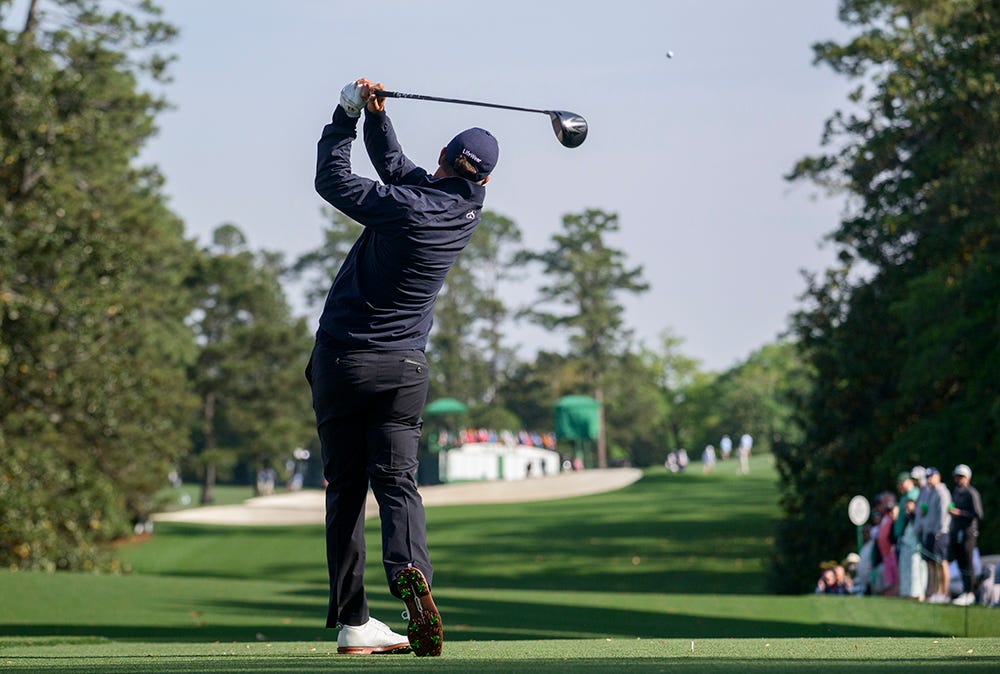
Adam Scott drives on the 18th hole during another perfect practice day (Kohjiro Kinno/Augusta National)
AUGUSTA, Ga. — If the weather forecast is right, this will be the best Masters week in 15 years.
For the first time since 2011, there is no precipitation in the forecast for the entirety of the Masters week. It’s difficult not to be excited for what is in store over the coming days at Augusta National for the 90th playing of the Masters Tournament.
With conditions likely to be the driest in recent memory, it means the potential for the firm, fast test that tournament organizers of all the major championships dream about being able to produce.
That’s what typically separates the best from the rest, with greens only holding well-struck shots and fairways that let errant drives run toward trouble. New Masters competition committee chairman Geoff Yang with have a perfect palette to set the course upon.

“It’s just looking so good,” said Adam Scott, the 2013 Masters champion making his 25th appearance. “It’s the way I like to see it. It’s getting firmer and likely getting faster as well. And the weather looks perfect. So it’s going to be play well and have a good score kind of stuff this week, and I think there’s going to be a lot of excitement.”
The course was already firm last Saturday for the playing of the Augusta National Women’s Amateur, and there was only the slightest precipitation late on Sunday since. There is no rain in the forecast through the tournament days.
The temperature cooled off into the 40s the last two nights and reached only into the mid-60s on Wednesday, but it will get progressively warmer starting with Thursday’s first round, with temperatures getting into the 80s on Saturday and Sunday. There is potential for light wind each day which makes for more indecision.
Because of the firmness of the course, some players have been re-thinking their equipment.
“I’m using a 7-wood this week because might need it on (hole No.) 4 and also the par-5s,” said Keegan Bradley. “The 3-iron is just not going to be high enough (in the air) so (with a 7-wood) I can hit that much higher.”
“This course tests you every single hole,” said 2017 Masters champion Sergio Garcia. “When it’s windy the wind switches and it’s really, really tricky. It’s testing you every single hole.”
Said Alex Noren: “The most fun thing about it is you get some roll on the fairways. Like on (hole No.) 2, for example, you can kind of use the fairway. Also fun hitting into greens. It’s always a lot of thinking here, but it’s even more when it’s dry. And it’s going to be interesting.”
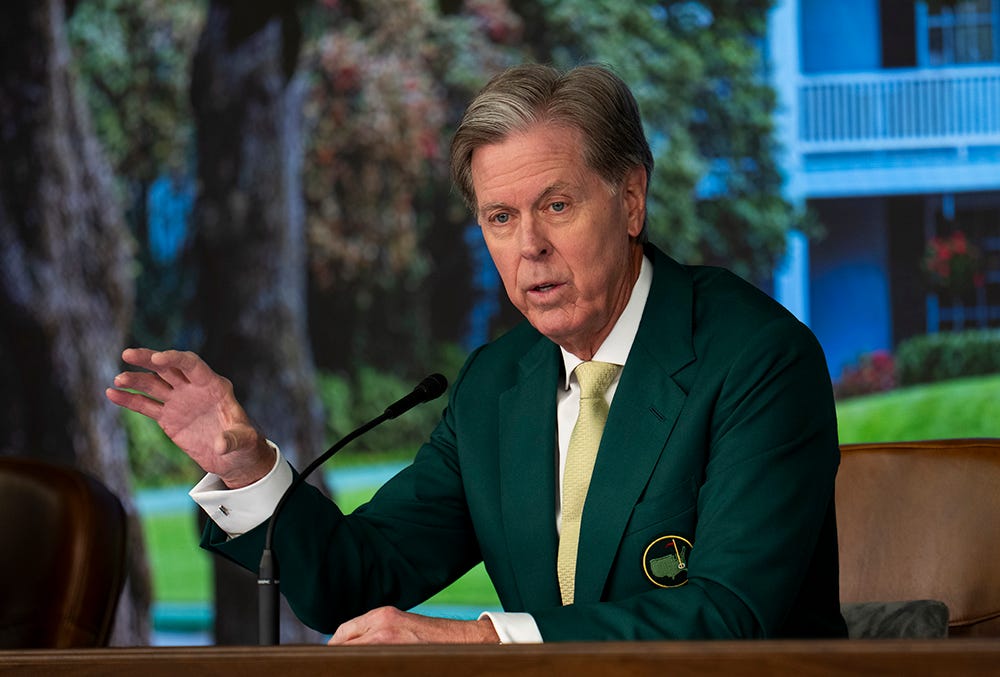
Fred Ridley wanting to get something off his chest about equipment regulation (Joe Toth/Augusta National)
Masters strongly supports ball rollback
Augusta National Golf Club and Masters chairman Fred Ridley made his strongest statements yet in support of the governing bodies’ attempts to reign in the distance modern players with modern equipment are hitting the golf ball.
Are the PGA Tour and PGA of America listening?
Ridley — a former U.S. Amateur champion, past president of the USGA and once chairman of the Masters competition committee — made it emphatically clear where he (and thus Augusta National and the Masters) stands when it comes to the announced rollback of the golf ball led by the USGA and R&A. He reserved the bulk of his scripted comments during his annual pre-tournament press conference about the issue.
“Finally, I’ve commented for the past several years on the subject of distance,” Ridley said Wednesday. “We have been consistent in our support of the governing bodies in their effort to regulate the distance elite players are hitting the golf ball. Recognizing that the implementation of the overall distance standard test for golf balls may be delayed to 2030, I want to reemphasize that support and affirm our position as the USGA and R&A represent their collective obligation as custodians of the game.
“I also want to be clear that our position is grounded on much more than protecting the Augusta National golf course. We will continue to make modifications as are necessary to react to driving distances that in some cases exceed 350 yards. Unfortunately, many courses, including some iconic venues, do not have that option.
“Until recent years golf has been a game of imagination, creativity and variety. The game has become much more one-dimensional. As players drive the ball prodigious distances and routinely hit short irons into par-4s and even some par-5s, this issue goes beyond competitive impacts. Increased course lengths result in more time, more cost and more environmental concerns.
“The data that has been shared with all stakeholders makes one thing clear: the impact to the recreational game will be immaterial. All of us in this room and millions of weekend golfers around the world will be hard-pressed to notice the effects of this change, and I do not believe our enjoyment of the game will be affected.
“As for professional golf, we hold firm in our belief that the greats of the game are defined not merely by how far they hit the ball, but their extraordinary skill in all aspects of the game. Their ability to shape shots, to take on risk and to execute under pressure is at the heart of championship golf and is best displayed through a full spectrum of shot-making opportunities.
“Regulation of the golf ball is not an attempt to turn back time or stifle progress. It is an effort to preserve the essence of what makes golf the great game that it is.”
In case any of the complainers among recreational golfers didn’t hear that, he called the ball rollback “immaterial” and said it will go unnoticed by the average hack. The focus should be on trying to contain the elite golfers who keep pushing the limits of technology to the detriment of historic venues.
He would also like the PGA Tour and PGA of America — the two most prominent entities to express skepticism and/or outright disdain for the ball regulations proposed by the governing bodies — to understand where the Masters stands.
If the PGAs choose not to abide by the rules of golf when the ball changes go into effect in 2030, then those players will almost certainly be playing a different golf ball when they show up for three of the four major championships on the calendar.
Ridley would prefer it not come to that.
