


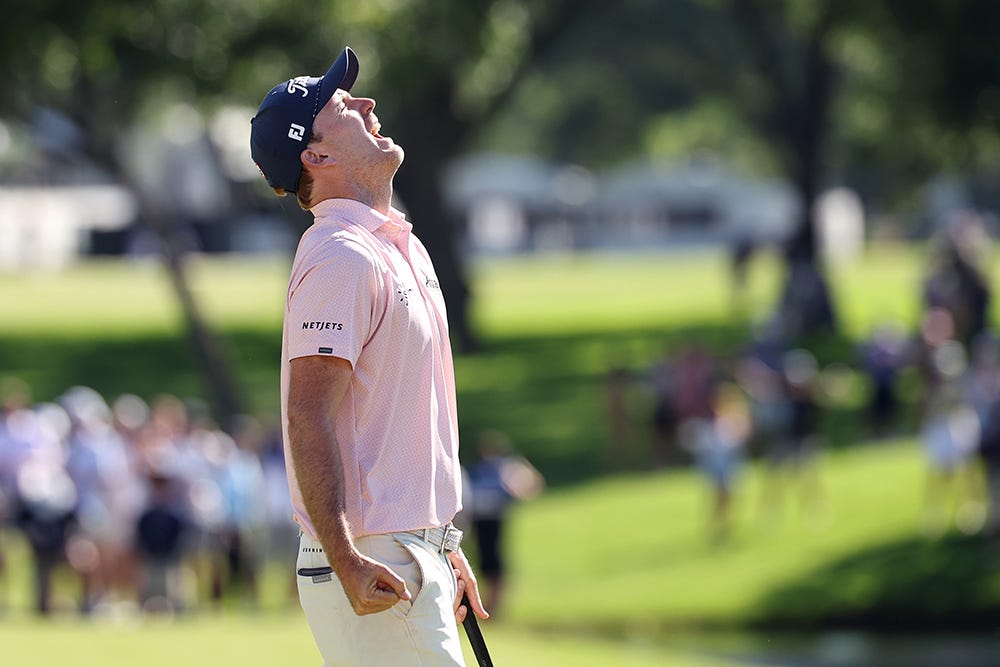
Russell Henley birdied four straight holes to win Colonial, er, Charles Schwab Challenge. (Stacy Revere/Getty Images)
While it pains the soul to hear the television broadcasters refer to the tournament won by Ben Hogan in 1946 as the Charles Schwab Challenge, there is no denying the event’s history at Colonial Country Club in Forth Worth, Texas.
Schwab, the financial guru, was born a decade after Hogan won the tournament for the first of five times at a course for which he became linked. Corporate marketing contracts and all that dictates that the event — known forever as the Colonial National Invitation or simply the Colonial — be referred to by its title sponsor name.
While the tournament’s history gets muddled amid naming rights, that history still matters, right? Or not?
As the PGA Tour forges a new path with private equity, player ownership and a for-profit model, you wonder about places such as Colonial Country Club, where Russell Henley birdied the last three holes in regulation (where was that hot putter in the clutch during that Ryder Cup?) and then the first sudden-death playoff hole against Eric Cole to win for the sixth time on the PGA Tour.
It’s doubtful that Colonial is going away but it is quite possible it is diminished. If the Schwab company doesn’t elect to step up with the necessary funding to help make it one of the proposed new Tier 1 events — believed to be $20 million purses — then it will fall into Tier 2. And, well … who knows what that means right now?
When Brian Rolapp took over as CEO of the PGA Tour, he quickly leaned into three tenets: parity, scarcity and simplicity. The latter was in regard to the competitive format that for 20 years has often been confusing — and at times, inconsequential — to golf fans.
But the scarcity part — which leads to parity — was all about streamlining the schedule, making events mean more, getting all of the leading players into more of the big events.
While that has generally been the case with the current signature-event model that will see the PGA Tour go to Jack Nicklaus’ Memorial Tournament this week, the ideas that are coming about for 2028 and beyond are bound to cause some consternation.
Rolapp has proposed a minimum of 16 Tier 1 events that would have 120-player fields. Nothing wrong with that. It’s better than the limited and often no-cut signature fields they have now. Both Golf Channel and Golfweek have reported, however, that that goal is to see them all have $20 million purses.
And that seems majorly ambitious and not necessarily wise. Of the current signature events, at least two of them are known to not be paying the full asking price that the tour requires for sponsors. So in doubling that number of big-money events, the tour believes that eight more sponsors are going to step up to that price point — which is basically double the going rate for a regular event now.
With the LIV Golf threat seemingly subsiding, it would appear this is a good time to reset the purse structure in the game, one that has gone way beyond sustainability with LIV’s $30 million payouts, the ones that led to the PGA Tour upping its ante to compete.
The number probably needs to settle in beneath that $20 million figure, and nobody is going to complain. There will still be big purses at the major championships, a $25 million purse at the Players Championship, and big hauls for the PGA Tour’s playoff series.
Perhaps of more concern is how the schedule will be configured, who will be in and out, what players will support which tournaments — and if they’re even allowed in Tier 2 events.
If you have 16 Tier 1 events, four majors, the Players and three playoff events, that’s 24 total tournaments. Most top players — not all — will settle in at playing 20 or less. That means the potential to skip four events, which means the PGA Tour is hopeful that the talent will spread itself around.
But a few others issues remain unresolved.
Two mainstays of the Colonial event — local residents Scottie Scheffler and Jordan Spieth — skipped last week. Both played the Dallas-based event (the CJ Cup Byron Nelson, to be sponsor-correct) in their hometown the week prior.
What happens if neither the Nelson nor Colonial are Tier 1 events? While that is unlikely, it is possible. Both Scheffler and Spieth have ties to the Dallas event that pre-date their professional careers. There has been some rumbling that the tour will either prohibit or highly discourage those eligible for Tier 1 events from playing in Tier 2 events.
A compromise floated is that they be allowed to play the lower event but without benefit of earning any points, only prize money.
But playing one of those tournaments, which are likely to have far-reduced purses, means perhaps skipping one of the bigger ones. And if that happens too often, the sponsors of those bigger ones start to wonder what the are paying for.
As it stands this year, the schedule is such that players are all but forced to skip events they like. Scheffler skipped the Truist Championship the week prior to the PGA Championship because he knew he had the Nelson and the Memorial — where he is defending champion — coming up.
The Cadillac Championship at Doral last month had five players eligible via last year’s FedEx Cup list skip — the most marquee absentees in the signature-event era. It preceded the Truist and the PGA Championship. Something had to give.
“So it’s very situational of when you play, don’t play in that regard,” said Justin Thomas last week as he had entered the Colonial. “But, I mean, I really, really, really try with all my might to not do four in a row. Four in a row is like I’m not fun to be around. It’s very taxing. So I try to cap it at three. And, yeah, there’s a lot of great tournaments, we’re very fortunate to have to miss some great events, but you have to at some point. So just kind of start with the majors and fill it in here and there, I guess.”
And that will be the trick for Rolapp and the future competition committee as it comes to scheduling these Tier 1 events. There need to be built in “off weeks” that allow players to properly prepare for the major championships while seeing clear to playing in as many of these tournaments as possible.
Scheduling two of them leading into a major championship — as was the case this year with the Cadillac and the Truist — is a bad idea. So is having too many in too short of a time period — as was the case with the Masters, RBC Heritage, Cadillac, Truist and PGA stretch that saw those five events in a six-week period.
How players earn their way into them, if they are able to play their way up to them during the season, and how you get relegated out of them are all to be determined. Which means the new-look PGA Tour has yet to fully come into focus.
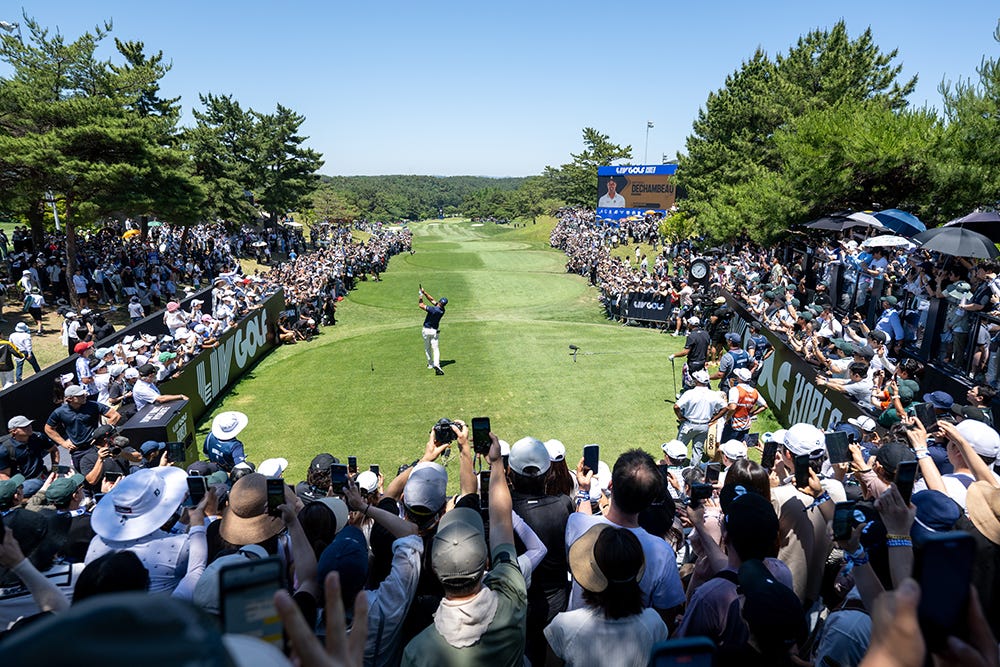
Bryson DeChambeau tees off in front of big crowds at LIV’s Korea event (Charles Laberge/LIV Golf)
LIV Golf and its cost-cutting realities
The crowds appeared boisterous and the vibe looked positive at the LIV Golf Korea event won by Joaquin Niemann on Sunday.
While that is undoubtedly what CEO Scott O’Neil and LIV leadership hoped for as a sign of positivity going forward, another aspect that occurred at the tournament was a sign of the difficult financial struggles ahead.
One of the innovative features that has been part of the LIV Golf broadcast was dropped without notice, part of what a spokesman told Sports Business Journal was a “strategic decision” as the league assesses its future.
Called “Any Shot, Any Time,” it was an innovative feature on the live stream of the broadcast that allowed subscribers to have access to group and team streams. The cost for the season was $59.99 and LIV said it would be working on a refund for those who no longer want the service due to this change.
The Masters has an every shot feature on its app but it is not live. It offers the ability to go back and watch every shot after a period of time has passed. The PGA Tour shows every shot at its annual Players Championship.
A company called Mobii was providing the “Any Shot” technology to LIV Golf and the company has not been paid for months. It is unclear if Mobii then decided to discontinue.
But the service will not be available for the rest of the season, which includes five more events starting with this week’s tournament in Spain. Afterward, LIV doesn’t play again until late July as its tournament in New Orleans scheduled for later this month was scrapped in the wake of its financial issues.
LIV Golf, now in its fifth season, is enduring a tumultuous time after the announcement last month that its main benefactor, the Public Investment Fund of Saudi Arabia, would be pulling its funding following this season.
The PIF, Saudia Arabia’s sovereign wealth fund, has spent some $5 billion on the controversial league and while it pledged funding for the rest of this year, it is unclear if it is doing so to the levels previously supported.
O’Neil has vowed to try and forge on by analyzing all aspects of the business — which could mean reductions in tournaments and prize funds — while seeking investment from companies interested in the league or in its franchises.
Golf and fitness to recovery is my interest 🔥👌I absolutely agree, being to every Open since 1996 in Blackpool, great post!
Being able to follow every shot from your favorite golfer would be a revolutionary addition to the PGA Tour.
My guess is Jordan would pull in the most views... lol