


The Daily Drive is a reader supported newsletter. For about $1 a week, your paid subscription can help sustain our full-time coverage of golf.
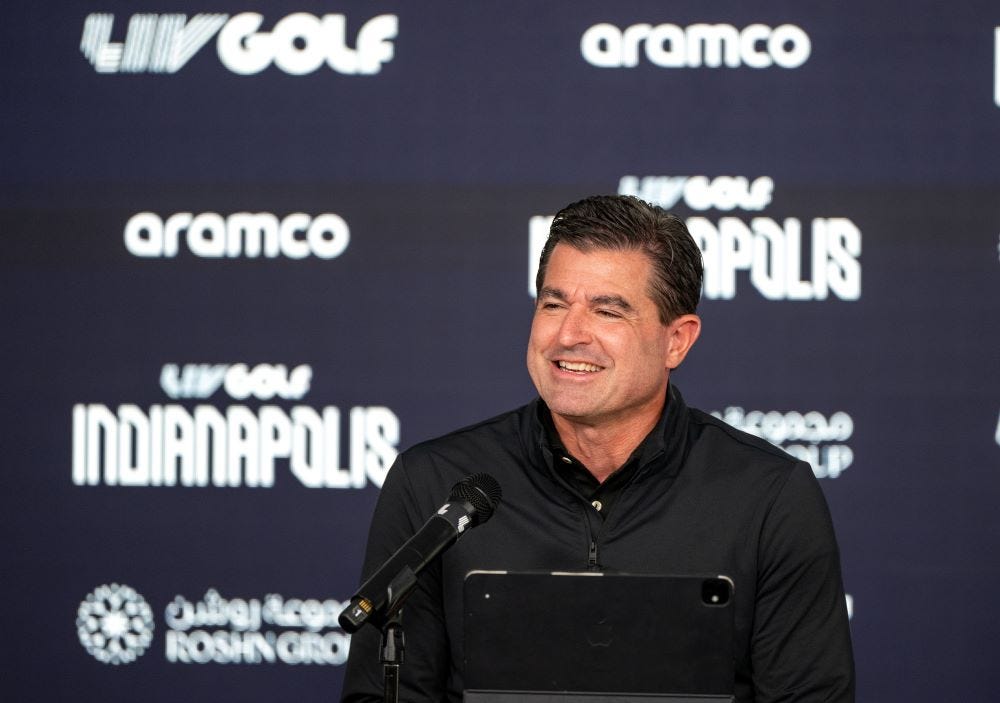
CEO Scott O’Neil promises “sustainable business model” for LIV Golf 2.0 after bankruptcy. (Montana Pritchard/LIV Golf))
There is certainly plenty to unpack from LIV Golf’s bankruptcy filing on Tuesday, which included a restructuring agreement as a way to move on from five years of exorbitant spending that would see players get equity in a new, leaner league.
The filing was made in the District of New Jersey and several players are owed millions of dollars. As part of the filing, LIV Golf disclosed that Saudi Arabia’s Public Investment Fund is providing $49.6 million in loan financing during LIV’s bankruptcy.
Ostensibly, those funds would be used to fund operations through the Chapter 11 process and settle outstanding financial issues associated with LIV 1.0 — with the court deciding on what various contracts are worth — thus allowing LIV Golf to move on from the PIF and set a new course of operation.
LIV is in this predicament because of the PIF’s April decision to no longer back the league beyond this year. In truth, the Saudi sovereign wealth fund has slow-paid on various commitments, which is why there are so many reports about creditors getting in line to receive funds owed.
The new LIV 2.0 clearly wants to move on from those obligations, thus this strategic bankruptcy move. The first bankruptcy hearing occurred Wednesday with another scheduled for Oct. 7. This is going to take a bit of time to play out.
But if you want some insight into the struggles LIV Golf faced since its 2022 inception, one aspect that came out in the filing: it’s media rights revenue.
And it is shockingly low. Lower than almost seems possible.
Also in today’s DD …
Folds of Honor Collegiate concludes in Michigan
U.S. Ryder Cup goes with new selection criteria for 2027
As part of the filing, LIV Golf reported that just 5 percent of its 2025 revenue came from broadcasting rights. It’s total revenue for that year was in the $210 million range, which means it was getting just more than $10 million for the year for its 14 events — or less than $1 million per event.
There are a couple of ways to look at this.
For example, the Daily Drive reported in June that LIV’s television production budget, according to sources, was $85 to $90 million, or roughly $6 million per tournament. Do to the math. The league was not coming close to covering its TV costs.
By comparison, the PGA Tour has 42 events on its 2026 schedule (not including the major championships) and is reportedly receiving $700 million in domestic media rights (doesn’t include its international deals). It is a very simplistic breakdown, one that equates to more than $16 million per tournament. It doesn’t work out quite that smoothly — signature events, for instance, are going to bring in more media rights revenue than a regular event which gets more than an opposite event.
But generally speaking, the PGA Tour has a robust media rights deal. Some 60 percent of its revenue is derived from media rights. And it also has sponsorship of nearly all of its events. Those sponsorship fees coupled with media rights more than cover the tournament purse — and the PGA Tour is not responsible for the production costs, as LIV Golf has been.
It’s a stark difference and is just one glimpse into LIV’s financial struggles to compete with the more established tour.
From the beginning, LIV leadership said that it had vetted among various television experts that a shotgun start with all of the players on the course at the same time and within one TV window would be well received.
But LIV didn’t have a U.S. deal the first year — showing its tournaments for free via YouTube and on its website. In the early days, exposure was probably more important than getting a rights fee. But at some point, that revenue would be imperative for survival.
In the second year, LIV did a revenue sharing deal with the CW Network in 2023 and 2024, and was part of Fox Sports the last two years. Based on those figures, LIV Golf more or less begged Fox to take on the broadcast at a loss for the league.
How it sells future broadcast rights will be among numerous hurdles for a LIV 2.0, but in theory, the cost of doing business will be considerably less.
“The next phase of LIV Golf will be built around a sustainable business model and deeper alignment between players and the league, with team golf at its core,” LIV Golf CEO Scott O’Neil said Tuesday. “Players will have the opportunity to share directly in the value they help create, while teams will be positioned to grow into enduring global sports businesses. And fans will remain at the center of everything we do.”

A word from Folds of Honor
This week’s Daily Drive newsletter is being sponsored by the Folds of Honor Collegiate, a 54-hole event that concluded Wednesday at the Jack Nicklaus-designed American Dunes Golf Club in Grand Haven, Michigan. Michelob Ultra is the event’s presenting sponsor and is joined by broadcast partners Sinclair Oil, Titleist, Compliance Solutions and TIAA. Next year’s tournament is scheduled for Sept. 5-8, 2027.
Now having completed its fifth year, the event is part of the fundraising mission of Lt. Col. Dan Rooney, who in addition to his military accolades is a Class A PGA of America professional who attempts to land wedge shots as deftly as he does F-16s.
Rooney founded two nationally ranked golf clubs, the Patriot Golf Club in Tulsa, Oklahoma, as well as the American Dunes Golf Club in Grand Haven, Michigan, site of the tournament. The course was designed for free by Jack Nicklaus.
He’s also a motivational speaker as well as best-selling author whose books include “A Patriot’s Calling” and “Fly Into the Wind.”
Rooney has continued his military service after three combat tours to Iraq where he flew the F-16 Viper. He is currently serving as the Commander of Recruiting for the Oklahoma Air Guard.
The Folds of Honor Collegiate raises awareness and funds for Folds of Honor and its mission to provide educational scholarships to the children and spouses of fallen or disabled military service members and first responders.
For more information, visit Folds of Honor.org.
Georgia Tech, Florida State capture FOHC titles
Georgia Tech freshman Max Amberson led wire to wire in his first collegiate start, shooting a final-round 67 at American Dunes Golf Club to win by two strokes over Texas junior Daniel Bennett.
Amberson’s 11-under effort along with teammate Albert Hansson’s T6 performance at 5-under helped the Yellow Jackets cruise to the team title as well by five strokes over Texas and Notre Dame.
“We have been building since June 4th for this,” said first-year Georgia Tech coach Ryan Hybl. “I am so proud of our guys and their work this week. I can’t thank Folds of Honor and Colonel Rooney enough for everything they’ve done this week.”
Emberson becomes the first true freshman Yellow Jacket to win a multi-team tournament in their collegiate debut since Luke Schniederjans in 2016. Emberson is also the first GT freshman to win their first collegiate start since red-shirt freshman Bartley Forrester in 2020.
“Everyone in this tournament, we were playing for something bigger than ourselves this week,” said Emberson. “Representing the Folds of Honor and the past and present service members, so every time you hit a good or bad shot, [you] just had to remember that.”
Click here for the men’s scoring.
In the women’s event, individual co-medalist Haruhi Nakatani helped Florida State overcome a seven-stroke deficit to win the team title by one shot over Texas A&M and two ahead of ACC rival Duke.
Entering the final round in third place and seven shots behind Kansas, the Seminoles fired a 5-under 283 lead by Nakatani’s 4-under 68. A sophomore from Tokyo, Nakatani made four birdies in the final round, including one on the 17th hole that brought her into a tie with co-medalist Mia Hammond, a Duke freshman. Nakatani’s par on the 18th hole secured the team title over the Aggies as well as her first collegiate victory.
“I am extremely proud of the way we played this week,” said FSU head coach Amy Bond. “We got better as the tournament went on, and today the team showed a lot of grit. This was a great start to the season.”
Hammond, who shot a final-round 69, is the third Blue Devils golfer to win her first college tournament, joining Amanda Blumenherst (2005) and Candy Hannemann (1998).
Click here for the women’s scoring.
Tightening up Ryder Cup qualifying
For the first time, the U.S. Ryder Cup team automatic qualifiers will not be based on any events in the previous year. The PGA of America announced the qualification criteria that will begin in January 2027 at the American Express Championship and will run through the BMW Championship, the week prior to the Tour Championship.
That means none of the major championships from 2026 will have awarded points toward qualification. Although it is a small number of tournaments, it was always odd that any consideration would be given to events more than a year in advance of the Ryder Cup, which will be played in September 2027 at Adare Manor in Ireland.
The top six points earners during the 2027 PGA Tour season will automatically earn a spot on the team. U.S. captain Jim Furyk will make six at-large selections following the Tour Championship.
There are 31 qualifying events, with a points allocation giving 3,000 to the winner of major championships, 2,850 to the Players Championship winner, 2,250 to signature and playoff event winners and 1,500 to the winner of regular tour events. There will be no points awarded at opposite events. All players making a cut will receive a percentage of points.
Many aspects of this that haven’t been considered at this is likely one of them
LIV is done, asta la vista baby