


The Daily Drive is a reader supported newsletter. For about $1 a week, your paid subscription can help sustain our full-time coverage of golf.
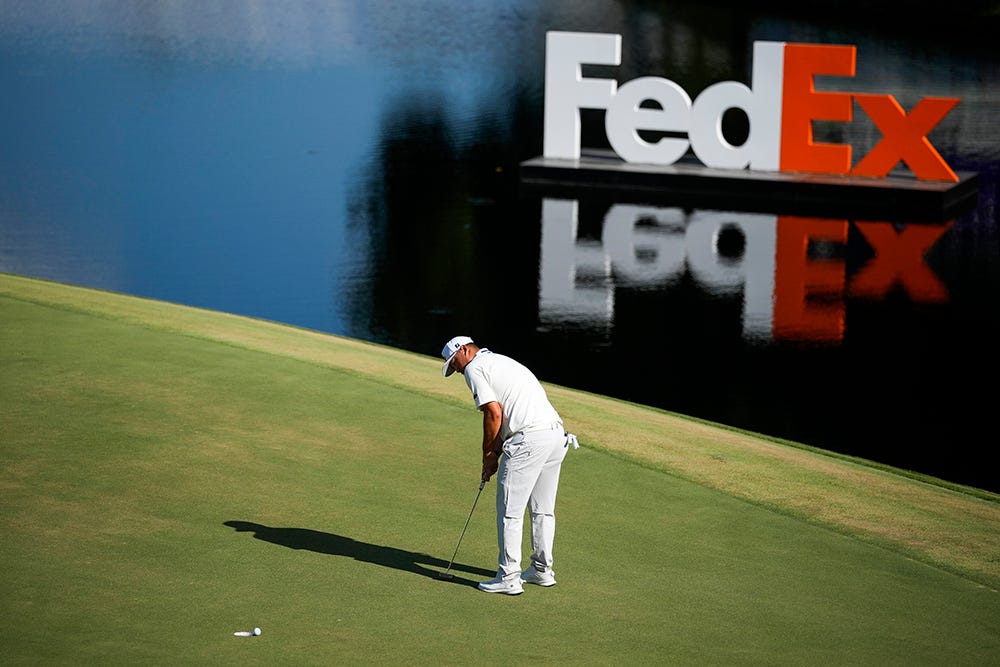
Sungjae Im was lone player to move up in Memphis to advance to St. Louis. (Tracy Wilcox/PGA Tour via Getty Images)
Only one player moved into the top 50 of the season-long standings and thus advanced to this week’s BMW Championship and Scottie Scheffler has already locked up the $23 million in bonus money that goes to the points leader prior to the Tour Championship.
In case you were wondering why the FedEx Cup “playoff” system is set to be blown up and potentially (hopefully?) simplified, see the above sentence.
“I talked about it the last few years, I think it’s silly,” Scheffler said during a news conference two years ago of the starting strokes and the whole playoff system. “You can’t call it a season-long race and have it come down to one tournament.”
It seems every time the PGA Tour has tried to rectify one problem or another with its postseason, it only creates a new one.
The “starting strokes” format that was implemented from 2019-24 — giving the points leaders various stroke advantages at the start of the Tour Championship — was scrapped because it ultimately proved to be unpopular with players and fans, even if its intentions were sound. Nobody liked (or saw the fairness) seeing the best player in the world get a 10-stroke advantage on the bottom of the 30-man field before anyone teed off.
In its place starting last year, the decision was made to make the Tour Championship a standalone tournament with a $40 million purse and the FedEx Cup trophy (and $10 million) going to the winner at East Lake. It was the simplest solution.
But in doing so, the tour needed to put an emphasis on the points accumulated all season leading up to the Tour Championship. So it decided to pay out the big bonus money following the BMW Championship, the penultimate event of the season which this week is being waged at Bellerive Country Club outside of St. Louis.
Also in today’s DD …
Is less really more or just less for Rory McIlroy?
The Chick who inspired the Evans Scholars Foundation
The LIV Golf soap opera will awkwardly conclude 2026 (at least) in Indy this week
That required altering the volatility it had built into the playoff points system to try to create drama. Instead of a massive points boost at each of the first two playoff events as had been the norm (2,000 points to the winner as opposed to 500 for a regular event and 750 for a signature events and majors) it kept the points at signature-event levels, meaning the chance for movement from the bottom 20 spots into the top 50 or 30 would be far lower.
That might not create excitement but it came down to the issue of fairness over flashiness. Otherwise, you are penalizing someone at the top like Scheffler — who had a lead in the points for most of the year but could potentially get passed because someone has a hot week or two at the right time.
It’s why the plan to create a playoff system for the PGA Tour has always had holes.
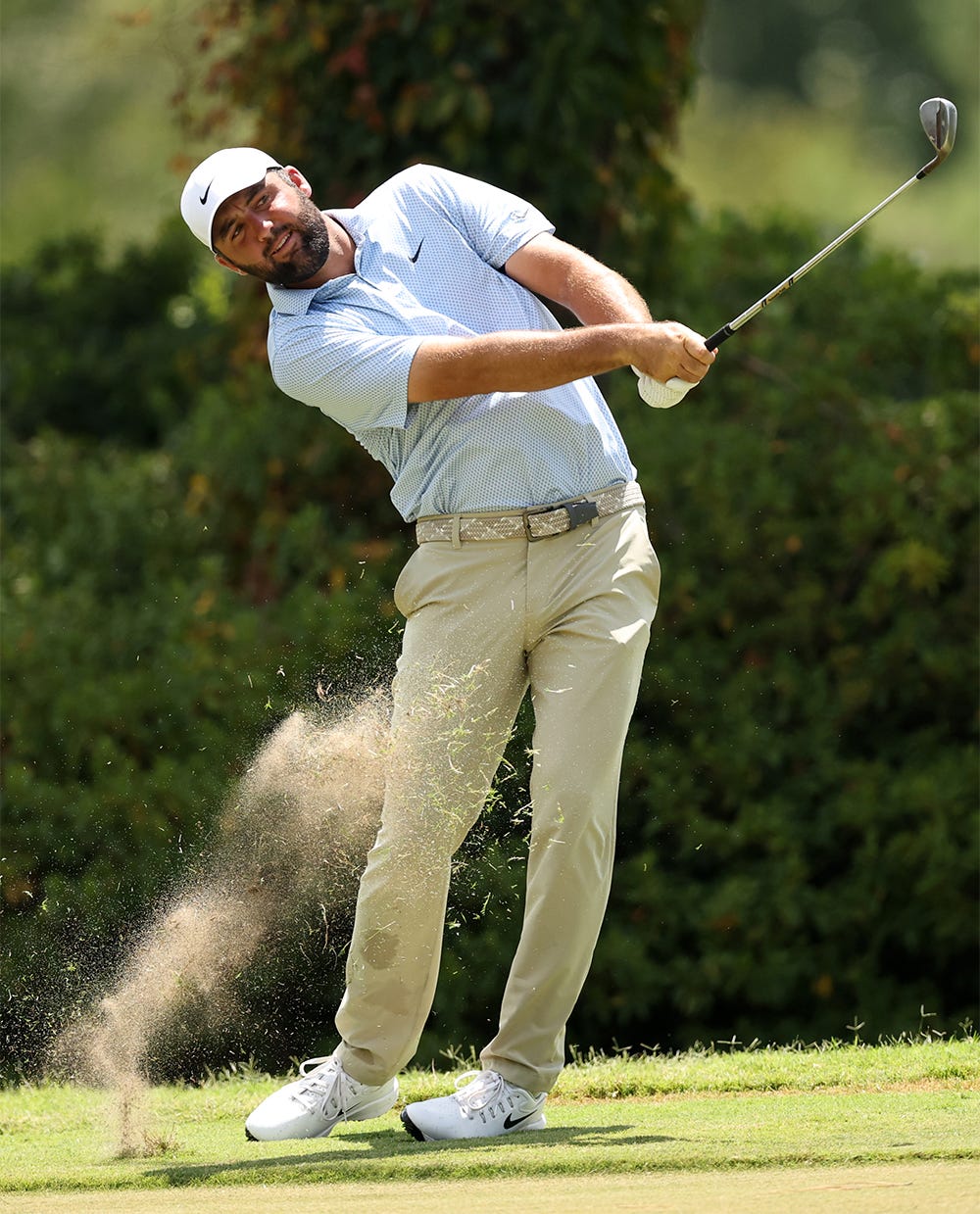
Scott Scheffler already clinched $23 million bonus (Stacy Revere/Getty Images)
The latest tweaks led to what occurred last weekend in Memphis. Scheffler already wrapped up the points title with a commanding 1,447-point lead over second-place Matt Fitzpatrick. And only Sungjae Im moved from outside (53rd) to inside (40th) the top 50 with his T5 finish in the FedEx St. Jude Championship. Consequently, only Keith Mitchell was bumped out (from 49th to 51st) after his T34 wasn’t good enough.
This week’s BMW Championship will determine the top 30 who advance to East Lake next week. Notably, only two players moved up into the top 30 after Memphis, with Bud Cauley (34th to 29th) and Kurt Kitayama (33rd to 28th) pushing out Gary Woodland (31st from 27th) and J.T. Poston (32nd from 30th).
Making that top 30 is certainly a big deal. Anyone who reaches the Tour Championship is essentially exempt for all the major championships in 2027 (only Masters, U.S. Open and Open Championship reserve automatic spots for the top 30, but nobody that high ever gets left out of the PGA either). They also get to compete for the largest one-week individual purse in golf and a $10 million first prize.
Ask Tommy Fleetwood how he liked the new format last year. The Englishman won the 2025 Tour Championship and thus the FedEx Cup title along with his first PGA Tour victory. No issues there. It’s all fair and square. But the system has long cried for something better to crown a season-long champion.
An example of something better? Take Rory McIlroy at the FedEx St. Jude Championship. The Masters champion admittedly came to Memphis to chip off the rust from a game that had been idle for three weeks since the Open Championship.
After skipping the first playoff event last year, McIlroy played last week and finished 66th out of 69 players who teed it up. He dropped one spot from 12th to 13th in the standings. He’s assured of getting to the Tour Championship and could have skipped the tournament and not fared any worse.
McIlroy knows how the system works and did nothing wrong either when he skipped or when he played. But the format would arguably be far better and have more actual playoff intensity if it simply scrapped the points at the end of the regular season and started from scratch in the playoffs, with only the top 50 finishers in Memphis advancing to the BMW. And then do the same this week, with only the top 30 finishers at Bellerive advancing to Atlanta.
Why don’t they do it that way? Well, because there is risk of a marquee player like McIlroy finishing 66th and getting eliminated. The PGA Tour and its sponsors are averse to that risk. They want the top players to advance, understandably.
Had a true elimination playoff system been in place, you can be assured that McIlroy would have arrived in Memphis far more ready to compete to make sure he moved on. You don’t see Kansas City Chiefs quarterback Patrick Mahomes sitting out a divisional playoff game to be rested for the Super Bowl because a wild-card team could knock them out any given postseason week.
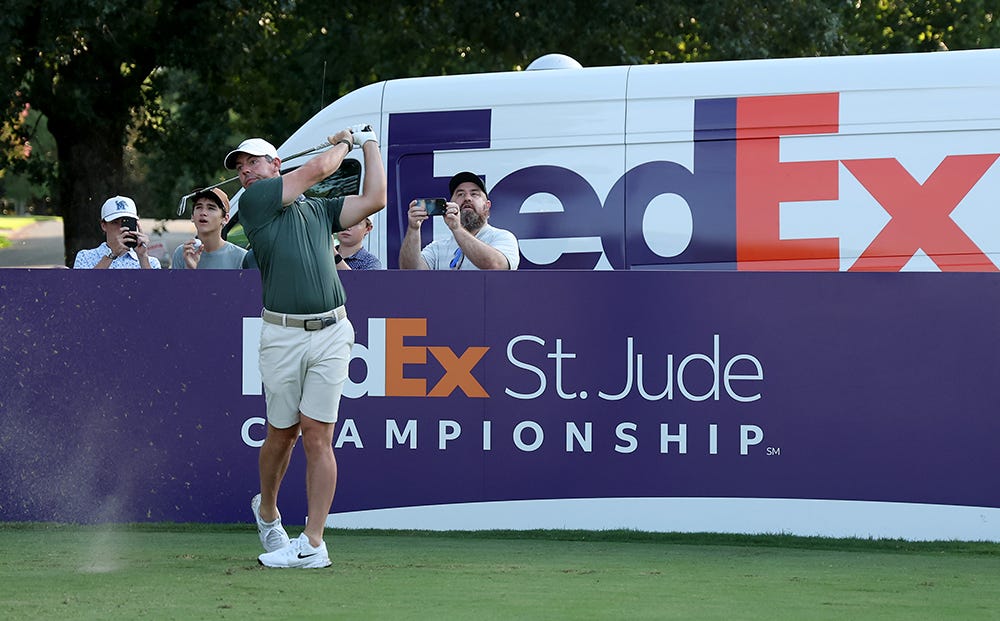
Rory McIlroy solo 66th in Memphis was no better than a DNP in 2025 (Andy Lyons/Getty Images)
But McIlroy faced no such risk, so he wasn’t required to either play or be at his sharpest. But if he had to finish top 50 to advance, he’d have been better prepared and would have competed in every round with a far different intensity trying to survive and advance. The same goes for Open champion Ryan Fox who finished T58 but still remains in the top 30. Or Robert MacIntyre, who bailed after a bad first round (82) but still made it to St. Louis this week.
It’s unclear if the PGA Tour will make any changes to its postseason format for 2027, which is the last year of the umbrella sponsorship by FedEx. But the tour has already signaled things will be different in 2028 under its new two-tiered competitive model split into a Championship Series and Challenger Series.
PGA Tour CEO Brian Rolapp has made a point to say that the regular-season Championship Series points champion — basically ignored now — will be recognized for his season-long accomplishment. That suggests a bonus following the last event, which during the 20 years of the FedEx Cup has been the Wyndham Championship in Greensboro, N.C. Then a new playoff series will be implemented — with the possibility of some kind of match play floated as part of the format — creating more of a true playoff element for those who qualify.
It’s possible we will get more details from Rolapp next week at the Tour Championship, though they still have another year before the new competitive model launches in 2028 and two years before we reach that postseason. In the meantime, it’s important to remember the overall goal of the playoffs when the FedEx Cup was first instituted in 2007 — to have some meaningful golf at the end of the PGA Tour season without it limping into the fall.
By and large, the FedEx Cup — warts and all — has done just that.
Is less more or just less for McIlroy?
Rory McIlroy has clearly been trying a less-is-more approach to his golf this season. While it worked well leading into the Masters — where he became just the fourth player to successfully defend the green jacket — it hasn’t fared particularly well since.
McIlroy has played only seven times in 18 weeks since winning his second green jacket in April, and he’s really not been a final-day contender in any of those seven starts. His performance in the subsequent majors (T7, T32 and T40) was particularly disappointing given that he certainly showed the ability to win more of them.
After the Open Championship, where McIlroy tied for 40th, he put the clubs away for a few weeks and obviously was using last week’s FedEx St Jude Championship as a way to sharpen his game again leading into this week’s BMW Championship and next week’s Tour Championship.
But even McIlroy admitted something was amiss.
“Obviously didn’t come in here with a ton of reps, almost felt like the more the week went on, the more I felt lost with my golf swing a little bit,” he said Sunday after failing to break par all we and finishing 66th of 69 players at 8-over par. “I figured it out a little bit the last few holes, I think. I just sort of — swing wasn’t in sync and obviously didn’t do a ton of practice coming in here.
“I guess nice to shake the rust off a little bit, but I’m going to have to work pretty hard between now and next Thursday to feel like I have any sort of golf game to compete (at Bellerive).”
That’s a bit of an ominous sign for the three-time FedEx Cup champion who still has a good bit of golf to play this fall.
“To me it’s more about obviously the execution of what I’m doing right now, and the execution wasn’t there this week,” McIlroy said. “As I said, I’m going to have to sort of put the head down and grind from now until Thursday to try to feel like I have any sort of chance (this) week.”

A word from our sponsor …
This week’s Daily Drive newsletter will be brought to you by the Western Golf Association and the Evans Scholars Foundation, which has been sending caddies to college since 1930.
The WGA, which was founded in 1899, sponsors six golf tournaments, including this week’s BMW Championship at Bellerive Country Club near St. Louis. The proceeds from the tournament benefit the foundation, which now has 1,310 students attending 28 universities.
The scholarship’s namesake is Charles “Chick” Evans Jr., who won the 1910 Western Open at Beverly Country Club, defeating George Simpson 6 and 5 when the event was contested as match play.
The Western Open was first played in 1899 and went through 2006 with that name (CBS’ broadcaster Trevor Immelman won the final Western Open that year) before it became the BMW Championship in 2007.
Evans became the first player in 1916 to win the U.S. Amateur and U.S. Open in the same year. He also won the U.S. Amateur in 1920 and played in the oldest American golf championship a record 50 consecutive years. Evans won the Western Amateur, which is also administered by the WGA, eight times.
As the LIV Golf world turns
On Monday we asked a few questions concerning LIV Golf’s rocky end to the season, a few of which were answered in advance of this week’s LIV Golf Indianapolis tournament.
This week’s tournament will — as predicted — be the season-ending event and will see individual stroke play for 72 holes with the usual podium acknowledgement for the top three finishers. Jon Rahm already sewed up the individual season championship a week ago in New Jersey.
Since the previously scheduled season-ending Team Championship in Michigan was — finally — canceled on Monday (the golf world knew for weeks that the event would not be played, but it took until Monday to be official), LIV will declare the winner of this week’s team scoring (all four players count every day) in Indianapolis as the official 2026 team winner.
So even though the 4 Aces team leads Ripper, Legion XIII and the Crushers in a pretty tight four-way points battle in the season-long standings, if the moribund Majesticks or Korean GC at the bottom of the standings manages some kind of inspired week in Indy, they’ll claim the season crown.
UPDATE: It turns out that 75 percent of the $40.1 million purse this week will be divvied up by the teams, with only $10.1 million for the individual pot. So the winning team will split $8.4 million each way while the winning player will get $2.02 million instead of the usual $4 million. There’s another $10 million to pay the top three spots in the season-long individual standings, with Rahm already securing the top prize of $6 million.
Golf.com reported earlier Monday that LIV Golf held off on announcing the cancelation of the Michigan event to avoid “additional media flags,” according to a memo website cited.
Later, Front Office Sports reported that several vendors and contractors are still owed funds, including some who have worked with LIV Golf since it began in 2022. The amounts owed vary from a few thousand dollars to as much as $100,000.
LIV CEO Scott O’Neil has been scrambling to put together funding to keep the league going beyond this year, but the Public Investment Fund of Saudi Arabia — which has backed LIV since the beginning but is pulling out after this year — had pledged to fund LIV through 2026. That claim appears to be dubious.
“The PIF is extremely difficult to work for,” a source told FOS. “And to get money from them is a huge pain in the ass.”
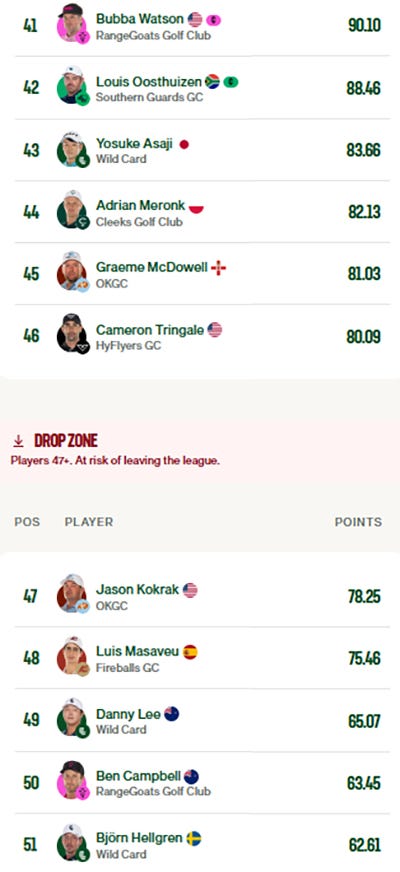
There is still a lot at stake this week for players who face relegation — assuming LIV Golf still exists next year — by not finishing among the top 46 in LIV’s season-long points standings.
My plan - Sit back and enjoy the golf!