


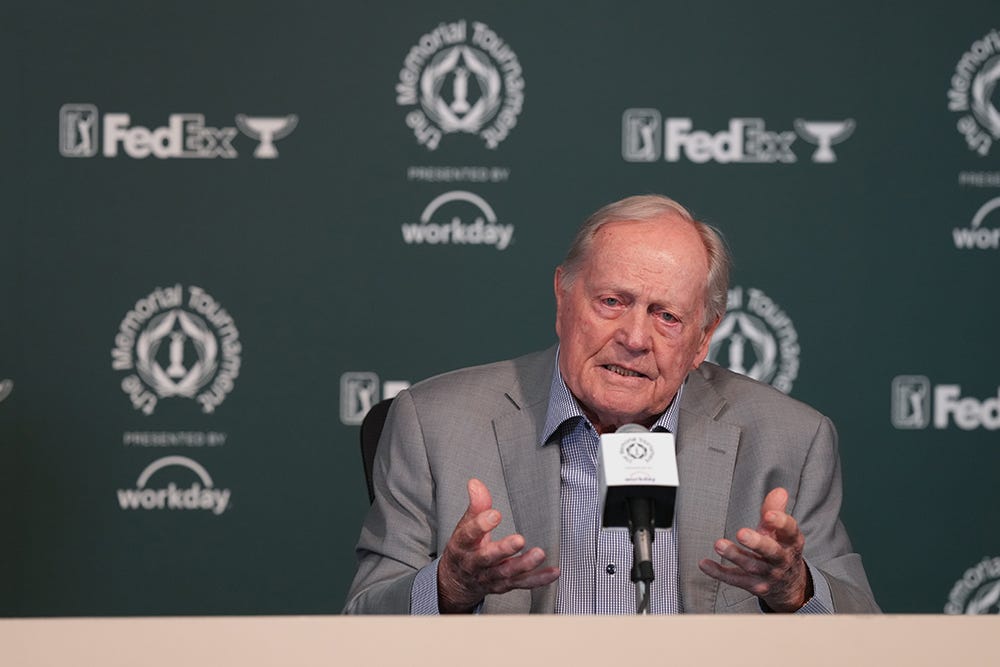
Jack Nicklaus holds his usual presser ahead of the Memorial (Ben Jared/PGA Tour via Getty Images)
If you look closely at the Muirfield Village logo, it is a wreath of laurel that encircles a trophy. That trophy is the Claret Jug, the prize for winning the Open Championship. Muirfield in Scotland is where Jack Nicklaus won the first of his three Open titles in 1966.
A decade later, Nicklaus launched his own PGA Tour tournament — the Memorial — that is now, remarkably, celebrating its 50th anniversary (its 51st playing) at a course Nicklaus designed in the early 1970s and named in honor of his first Open victory.
At 86, the Golden Bear is still a monumental presence at his own event in Dublin, Ohio, still a source of inspiration for the players who compete and a comfortable elder statesmen who seems to enjoy reminiscing about many of the aspects that led to this point.
“The reason it’s called the Memorial Tournament is that the Masters also is called the Masters Tournament,” Nicklaus said Tuesday during his annual pre-tournament news conference. “And why is the Masters called a tournament? Well, it’s called a tournament because Bobby Jones did not want it to be called a championship. Jones felt like he was using what the USGA and the R&A and the PGA and the players that played best in those three championships made up his field at the Masters, and he thought it would be presumptuous to call it a championship, so he called it a tournament.
“And I didn’t want to be presumptuous here in calling this any more than a tournament because I felt like our goal was to be of service to the game of golf and to try to further the game. Bring the game back to the place where I grew up. Bring it back to the people here.”
Nicklaus’ Memorial tournament became one of just a few marquee events outside of the major championships. It was before the days of World Golf Championship events and before today’s signature events. It came along just two years after the creation of the Players Championship and predated what is now the Arnold Palmer Invitational by three years.
The field of “major” non-majors is much more crowded today. The Memorial is one of eight signature events this year, a model that is expected to expand by 2028.
“I don’t want to comment on the tour’s schedule because I’m not exactly in favor of what they’re doing right now,” said Nicklaus, who then did exactly what he said he didn’t want to do.
“I really haven’t had a conversation. I want to sit down with (PGA Tour CEO) Brian (Rolapp) and Jay (Monahan) and have that conversation. I mean, I hate to see tournaments bunched too much together with too many big tournaments too close together. That’s a problem, I think. And I think that’s going to be a problem for the tour in the future.
“But anyway, that’s neither here nor there. I probably shouldn’t have brought it up here. I’ll get chastised for that later.”
“So to jam it all in in one period of time, and then leave the rest of the year open, I think it’s tough. … I don’t think it’s a problem yet, but I think it will be if we don’t address it.”
Jack Nicklaus on crowded signature schedule
The Memorial’s prominance is 60 years in the making going back to the championship that inspired his club’s name. In his first Open victory at Muirfield, Nicklaus trailed Phil Rodgers by two strokes through 54 holes. He shot a final-round 70 to reel in Rodgers and eventually beat Doug Sanders and Dave Thomas by a stroke. His prize for winning was £2,100, or about $2,900 based on today’s exchange rate. It would have barely covered the trip.
The victory, however, brought bigger rewards beyond the modest purse. It was Nicklaus’ sixth major title but first Claret Jug and made him the fourth player to complete the career grand slam, joining Gene Sarazen, Ben Hogan and Gary Player. (Tiger Woods and Rory McIlroy are the only players to complete it since.) Although it didn’t count as an official PGA Tour victory at the time (it was later added to his total), the win was his 19th along his way to amassing 73 victories, 18 of them majors.
Only 26 in 1966, Nicklaus already had his thoughts on bringing an event to his hometown in Ohio and began embarking on the mission to accomplish it.
“We started the idea of the tournament and bringing golf to Columbus in 1966 at Augusta,” Nicklaus said. “So it took us 10 years to get the golf course built, financed and move forward.”
Nicklaus said Joe Dey, a former USGA president who was the PGA Tour’s first commissioner, was instrumental in getting the event started, suggesting the Captain’s Club that still exists to help run tournament affairs. He also suggested the name.
“Joe came up with the idea of … he says, ‘It’s Memorial Day … why don’t we honor the past people who have contributed to the game of golf in the past?” Nicklaus said.
That led to the ongoing tradition that the tournament honors someone in the game. A Captain’s Club was formed to select the honorees and Nicklaus’ wife, Barbara, received the honor last year. Two-time major winner David Graham is the 2026 honoree.
The initial Captain’s Club had as part of it Clifford Roberts, who was at the time the first and only chairman of Augusta National Golf Club in its history. The first honoree was Jones, who founded the Masters along with Roberts and had passed away in 1971.
“The Captains Club was guys like Byron Nelson and Chick Evans and Gene Sarazen,” Nicklaus said. “Let’s see, Bob Hope, Bing Crosby, Sean Connery, all walks of life. Presidents of the USGA, captains of the R&A. And that group has come together, and it’s still that group. And I only ask two things of them. One is to select the honoree every year, and two, perpetuate your membership. And that took it out of my hands.
“And I’m not a member of the Captain’s Club. I never have been a member of the Captain’s Club. And I said, I want to be out of that position. They do the exemptions. They do everything that relates to the structure of the tournament.”
Roger Maltbie won the first tournament in 1976, a sudden death playoff win over Hale Irwin. A year later, it was Nicklaus who prevailed.
Nicklaus would win again in 1984 and went on to play the tournament 30 consecutive times through 2005. That was when he was 65 and also played in his final Masters and final Open.
In the ensuing years, Nicklaus has remained a constant force with the Memorial. Playing and organizing his own tournament might have been problematic, but there is still a flurry of activity, with a schedule planned out to the minute as Nicklaus meets with various dignitaries, sponsors, media, PGA Tour officials, tournament staff, Muirfield Village staff and players.
“He does such a good job at his tournament of being around, and the last few years especially, asking players about his golf course I think is a really cool thing that he does,” said Scottie Scheffler, the defending champion. “He wants this golf course to be the best test of golf, and so the last couple years he’s just been sitting in player dining basically asking guys what they think of the course. And he’s not sitting in there for everybody to be like, ‘Hey, we love it, it’s great, everything’s the best.’ He’s like, ‘No, I want you to tell me how we can continue to improve this tournament.’
“I think for a man that has the experience he has in the game of golf, for all the stuff he has accomplished, for him to be sitting in dining asking the current guys how he can improve his tournament I think is really cool.”
There’s no doubt, Nicklaus has been a tinkerer. He’s made numerous changes to the course over five decades and acknowledged that it his original intent was always to make it a top tournament course.
That, he said, was part of a design philosophy that has evolved over his time in the business.
“We always wanted to have a tournament, from its inception,” Nicklaus said. “And probably from a design standpoint I wouldn’t have designed the golf course this way. What I mean by that is I designed this golf course basically for a tournament, and spent the next 50 years trying to ease it enough so the average member can play it.
“I would have done it the other way around. Had it a little bit more user-friendly to start with, which is what I do now, more user friendly now. And if I want to lengthen a hole here or there to handle a tournament, I would do it that way.”
Nicklaus has never been shy in speaking his mind, and he’s earned that right. Among the many things he does during Memorial week is meet with the media, and that session on Tuesday again provided plenty of fodder. Among the topics covered were the tournament’s history, Rory McIlroy’s repeat Masters victory, whether anyone will ever match his 18 major titles and the golf ball rollback debate.
His words still pack meaning.
“I’m trying to make sure that just what we do here is right for the game,” he said. “Anything that the tour or anybody wants to sit down and ask me and talk about, I hope that I can, through the experience that I’ve had, be of some influence or what do you call it? Something to bounce off of, something to bounce, somebody to bounce off things.
“And I’m too old to worry about trying to create new stuff, I’m just trying to make sure that the game of golf — the game of golf’s a great game, it gave me everything that I had the opportunity to do.”
His concerns about the pending changes to the PGA Tour and how a crowded schedule of Tier 1 events will impact each tournament are worth considering.
“Anyway, I think it’s harder for your tournaments to stand out,” he said. “I mean, if you looked at the schedule, we’re involved in the Cognizant (Classic) down in Florida, and, we (follow) Pebble Beach and Los Angeles, Tiger’s event, and then Cognizant, and then we had Bay Hill and the Players. I mean, what chance does that tournament have? I mean, it sits right in the middle of those. They don’t have a chance.
“The other tournaments also say I got four out of five. It’s hard for guys to play that. See, the problem is not so much from the standpoint of players, it’s hard for the players to really be focused to play that much and be on top of their game. I look at it from the way I was as a player. I could play a couple weeks in a row, maybe three weeks in a row, but I needed some time off to be able to recharge the batteries. And I think everybody needs to recharge their batteries.
“So to jam it all in in one period of time, and then leave the rest of the year open, I think it’s tough. … I don’t think it’s a problem yet, but I think it will be if we don’t address it.”
Classic Jack. He expressed his opinion, strongly, but in the most unconfrontational way.
$2900 in 1966 is about $29,000 today.