


The Daily Drive is a reader supported newsletter. For about $1 a week, your paid subscription can help sustain our full-time coverage of golf.
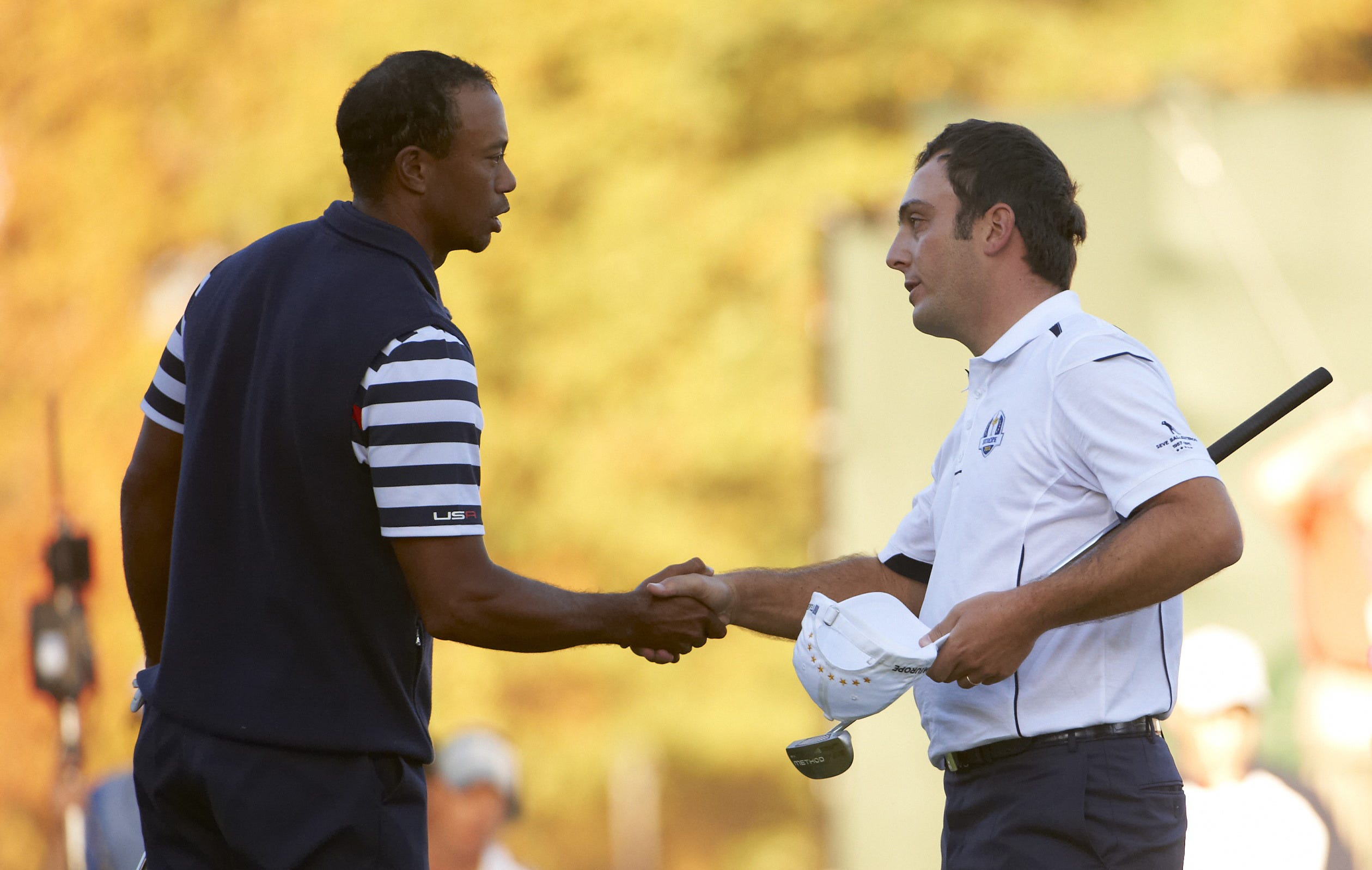
Tiger Woods-Francesco Molinari tie costs U.S. a tie in 2012 at Medinah (Fred Vuich /Sports Illustrated via Getty Images)
MEDINAH, Ill. — All these years since the European’s “Miracle at Medinah” and it remains difficult to escape an admittedly odd hangup: why didn’t Tiger Woods grind to forge an overall tie on the last hole of the anchor match he was winning in the 2012 Ryder Cup?
With the Presidents Cup on tap this week at Medinah’s No. 3 course, it’s difficult to see the ornate clubhouse and the massive property or even type the word “Medinah” without thinking back to what was one of the more remarkable golf events in history.
No matter your rooting interest, it would be impossible to dismiss the drama of the final day 14 years ago that saw the Europeans storm back from a 10-6 deficit to produce a stunning 14½-13½ victory. That comeback was only made possible by rallying to win the last two matches on Saturday to avoid an even deeper hole.
From Rory McIlroy arriving barely on time his singles tee time to the Europeans winning several early matches to spark momentum to the late turnarounds by Justin Rose and Sergio Garcia to tilt what seemed like sure victories for Phil Mickelson and Jim Furyk, respectively, into defeats, it was an amazing ride of emotion for both sides.
And then there was the final singles match between Woods and Francesco Molinari — the only match that ended all square that day. The Europeans won eight matches and the U.S. three and to reach the 14-point mark that guaranteed Europe retaining the Ryder Cup it won by one point two years before in Wales.
When Martin Kaymer rolled in a putt on 18 to secure a 1-up win over Steve Stricker and spark a European celebration, Woods was left watching from the fairway where he was 1-up on Molinari, whose drive was in a fairway bunker. If he just tied the last hole with pars, the final tally would have been 14-14, marking only the third tie in Ryder Cup history.
Woods made bogey from the middle of the fairway, lipping out a greenside chip for birdie before ultimately missing his 4-footer for par and conceding Molinari’s 3-foot par putt that squared their match and handed Europe the outright win.
Why does it continue to rankle? Because had Woods played it out properly and just tied the final hole — which he was easily in position to do — it would have salvaged a tie and denied Europe an outright victory. And while the Europeans would have still retained the Ryder Cup, a tie is still better than a loss and there’s no point in keeping a final score if a tie doesn’t matter — which it clearly does.
Woods didn’t appreciate the distinction.
“It was already over,” he said after. “We came here as a team this is a team event. And the Cup was already been retained by Europe, so it was already over.”
Also in today’s DD …
J.J. Spaun gets spicy about Prez Cup snub after Wentworth triumph
Stray Shots on Presidents Cup snubs and Dubs
A disclaimer: I’ve written about this in the past and questioned several of those involved about it, and most blow it off as Woods did at the time. The ultimate goal is to win the Ryder Cup, they say, and a tie doesn’t matter. So, typically, the argument is not won by me. And that’s fine.
But it still seems worth noting that the only two ties in Ryder Cup history were both a huge deal — even though the team that forged the tie didn’t win the trophy. And the only tie in Presidents Cup history — in 2003, and famously involving Woods who didn’t want to declare a stalement in his pressure-packed playoff with Ernie Els — was a pretty big deal, too.
Europe clinched the Cup that day at Medinah during the second-to-last match on the course when Germany’s Kaymer holed a dicey 6-footer for par that clinched a 1 up come-from-behind victory over Stricker. That assured a 14th point and a European victory, and a wild celebration ensued on the green, which was understandable.
Woods and Molinari watched it unfold from the fairway, and had they decided to simply walk in from there with Woods leading 1-up, the match would have ended at 14-14. Molinari had actually considered conceding, but European captain José María Olazábal understood the value of an outright win and didn’t want the Italian to concede the point. So after the green cleared, they played on.
“I thought about giving him the half in the fairway, but then the captain was there; they told me, it’s not the same, winning or halving, so get focused and do your best,” Molinari said. “And that’s what I did. So I basically just tried to win the hole, to win the tournament, basically.”
Having been on the bad end of Justin Leonard’s long putt and subsequent celebration in 1999 at Brookline that capped an American comeback from a 10-6 deficit, Olazábal was perhaps in no mood to do any conceding. But it speaks to his desire to win rather than tie. In his mind, it mattered. Why wouldn’t it?
For some reason, however, Woods was no longer fully engaged at this point. The stakes had changed right in front of his eyes, and the man who once called finishing runner-up “first loser” had lost his incentive. Surely he wanted to win his own match, right? Especially given his level of pride and the fact he was 0-3 at that point with three team losses alongside Stricker. But it seems he never really considered the notion of the entire match ending in a tie if he could simply make par and halve the hole to win the full point. It seemed obvious by the way he answered questions about it.
His dispirited approach flared right of the green and came to rest on the fringe behind some sprinkler heads. His chip up lipped out and rolled 4 feet by, just outside of where Molinari’s long cross-green birdie putt had come to rest.
Woods said he rushed the par putt because he didn’t think it mattered anymore, missing the cup entirely. He then conceded Molinari’s par and thus the hole, leaving the match all square with each player getting a half point.
“It’s pointless to even finish,” Woods said. “I’ve been out there twice when that’s happened, and it’s a tough spot to be in because you know you’ve got to finish out the match, even though it’s useless because our team didn’t get the Cup and they did.
“So 18 was just, ‘Hey, get this over with.’ Congratulations to the European team. They played fantastic today and they deserve the Cup.”
Nobody disputes that fact. Europe earned it. But a tie is better than a loss. And wouldn’t rookies on the team such as Keegan Bradley, Brandt Snedeker, Jason Dufner and Webb Simpson — who had no role in the 2010 defeat in Wales — prefer a tie over a loss on their résumés?
“I think it’s very awkward,” U.S. captain Davis Love III said later of the zombie-like conclusion after the Ryder Cup was already retained. “I saw some confusion on both sides. What do we do here? It’s over. There was a lot of disappointment, a lot of emotion on our side. I saw Molinari looking around, ‘what do I do here?’
“I just think when it’s over, we all shake hands and go. It doesn’t really matter the score. They had the Cup, and they knew it. They were celebrating while we were trying to get out of Tiger’s way and Molinari’s way to hit shots. It was very awkward.”
Only twice in Ryder Cup history has the event ended in a tie, and the circumstances were far different. But it’s unquestioned that the Great Britan & Ireland team was thrilled with the 16-16 score in in 1969 even though the Americans retained the Ryder Cup.
That was the famous “Concession” when Jack Nicklaus gave a putt to England’s Tony Jacklin on the final green at Royal Birkdale. Had Jacklin missed the short putt, he would have lost his match to Nicklaus and the U.S. would have won outright. Instead, they halved the match and the overall Ryder Cup ended in a tie.
Since GB&I had not won since 1957, it was a huge accomplishment to even tie. Sam Snead, the U.S. captain, was said to be furious with Nicklaus for conceding. The Golden Bear has been hailed for his sportsmanship for the better part of 50 years. Over a tie.
But a tie doesn’t matter?
In 1989, the Americans won the last four singles matches to earn a 14-14 tie at the Belfry. Europe retained the Ryder Cup based on their 1987 victory but the Americans took pride in their comeback. Who got the Cup had been decided but not the overall match. Lanny Wadkins defeated Nick Faldo 1 up in the second-to-last match. Curtis Strange defeated Ian Woosnam 2 up. Both matches went to the 18th hole of a decided Cup. But it didn’t matter?
“Damn straight, it did,” Strange said a few years later. “We were very much aware of the score. We weren’t just going to walk off.”
In the early days of the Presidents Cup, there was a playoff stipulation that came to fruition in 2003 in South Africa. After the teams finished in a tie, Woods and Els — the two biggest players in the world — went out for a riveting sudden-death playoff. The pressure was excruciating, and both players matched each other shot for shot, putt for putt for three holes. The drama helped put the Presidents Cup on the map. Encroaching darkness eventually prompted captains Nicklaus and Gary Players to agree to share the Presidents Cup.
Woods considered the intensity of that playoff the most pressure he’d ever felt in golf.
“I read my par putt from behind the ball and all I could see was nothing but a sea of red. The whole team together,” he said. “I miss this putt, I lose it for all of them. And that’s an experience I’ve never felt as an individual.
“Ernie and I, when we were done, we put our arms around each other and said, ‘Let’s never do that again. Let’s go have a beer.’ ”
Winning the Cup is always the main thing, obviously, but the PGA of America’s record book accounts for tie in the Ryder Cup. The U.S. leads the overall competition 27-16-2, as the two ties were not credited as a victory for either side even though each side retained the Cup. If so, the record would read 28-17.
The Presidents Cup record also accounts for ties: 13-1-1 for the U.S. But that lone tied was considered a shared victory by both sides instead of the U.S. retaining the Presidents Cup because it won the previous competition in 2000.
Snedeker is the U.S. Presidents Cup captain this week. He’s joined at Medinah this week by three assistants who were part of that 2012 Ryder Cup defeat — Bradley, Simpson and Furyk, who will captain the U.S. Ryder Cup team next year in Ireland.
It’s an interesting tidbit that all four lost their singles matches that day at Medinah. Bradley, who went 3-0 that week with Mickelson, infamously has never opened his Ryder Cup bag from that week, waiting to experience a victory which has never come his way in another chance as a player and in 2025 as captain.
It is also fair to suggest that none of them has spent much time lamenting a tie that could have been for the Americans.
Is this a big deal? Not at all. But it’s difficult not to consider the meaning of a tie as another big international team event takes place this week at Medinah.
A word from our sponsor
This week’s Daily Drive newsletter is being brought to you by Tohatsu, long-time builder of outboard motors, and Northeast Marine, which has extensive expertise in marine outboard repower sales, repair and servicing.
Tohatsu has a history that spans more than a century and covers the building of engines for air, road and water. Northeast Marine offers a selection of Tohatsu and Honda outboards, as well at C-Hawk and Mitzi Skiff boats with special financing programs available.
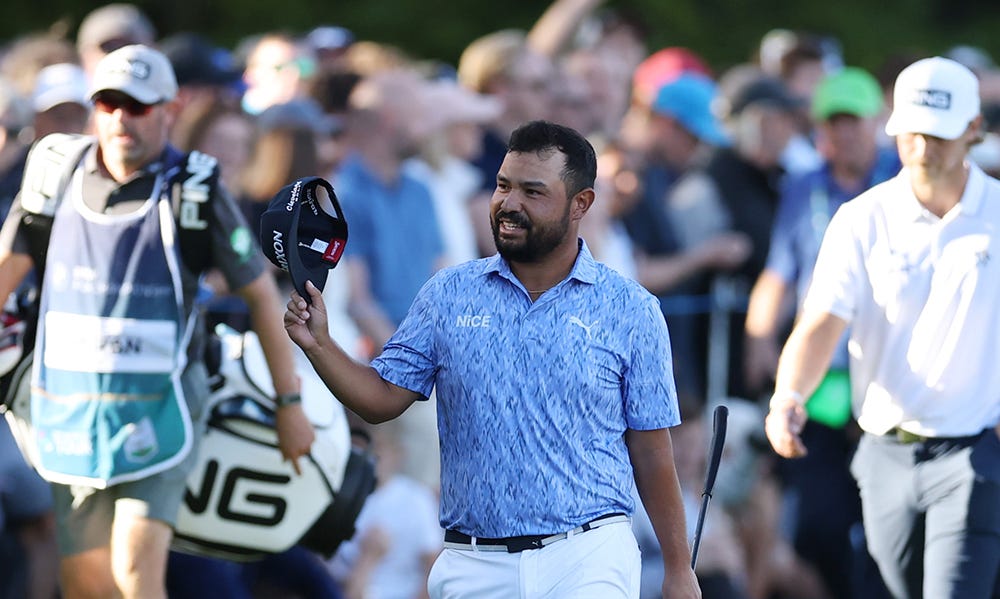
J.J. Spaun had something to prove in winning at Wentworth (Richard Heathcote/Getty Images)
A spicy Spaun and the Presidents Cup
J.J. Spaun’s victory on Sunday at the DP World Tour’s flagship BMW PGA Championship came with a good bit of saltiness afterward as the 2025 U.S. Open champion made it clear he was not pleased at being left off of Brandt Snedeker’s U.S. Presidents Cup team this week.
Spaun finished 10th in the final points standings that were official through the BMW Championship and then withdrew on the first day of the Tour Championship with a shoulder injury. A few days later, Snedeker added six players to his team, including rookies Jackson Koivun and Jacob Bridgeman, who, like Spaun each had one PGA Tour victory in 2026.
Bridgeman validated the pick with a second victory last Sunday at the Biltmore Championship Asheville, the PGA Tour’s first fall event, where Koivun finished tied for fifth. Patrick Cantlay, who was 13th in points and hasn’t won a tournament in four years, was another pick that made Spaun bristle.
“It was disappointing to be left off,” Spaun said after the second round of the tournament at Wentworth. “I kind of hung my hat on my experience with the Ryder Cup last year (he went 2-1). I made it to the Tour Championship this year. I won in San Antonio. I kind of did everything I could. I was the odd man out.”
Spaun said he had a brief conversation with Snedeker on the Monday after the Tour Championship. The captain never noted the injury excuse in media interviews, and it’s fair to wonder if that was part of his thinking. It’s also true that Spaun earned more points in 2025 when he won the U.S. Open and finished second at the Players Championship. Points are based on FedEx Cup points and the formula gives 1.5 points for 2026 events and 2 points for majors and the Players.
Over 26 events, Spaun earned 5,023 points, but more than half (2,794) were earned in 2025 when he had his breakout season. Call it a flaw in the system, but his year that saw him have four top-10s in 2026 wasn’t as strong as last year.
“I was pretty determined this week to kind of prove for something,” Spaun said after winning at Wentworth. “My whole career, I’ve kind of had to do that. I wasn’t given scholarships. I had a walk-on. I had to earn my PGA Tour card the hard way. I was never given sponsor invite opportunities. I just had to do everything the hard way.
“You know, being left off was obviously for a reason. I don’t know what that reason was, but I’m here now and there was a reason why we’re here. My caddie kept telling me that, and it’s crazy how this has happened. You know, everything does happen for a reason. I’m just super happy.”
Spaun is now likely to take up DP World Tour membership again after briefly holding it following his U.S. Open win.
Bridgeman certainly did Snedeker a solid by winning in Asheville, North Carolina, giving him a boost coming into this week’s competition.
“My goal to start the year was to win, make East Lake, and make the Presidents Cup, so I hit all those and hit the win category twice,” said Bridgeman, who won the Genesis Invitational at Riviera and qualified for the season-ending Tour Championship.
“Pretty amazing. Super excited about Presidents Cup. I’m very pleased with how I’m playing rolling into it, and I think everyone else is just as pumped as I am. Jackson and I were talking this week. We played the first couple days. It’s real now. We’re getting really stoked about it. Pumped about it.”
