


The Daily Drive will have coverage of the U.S. Open from veteran golf insider Bob Harig all week from Shinnecock Hills. To support our work as independent golf journalists, please consider subscribing for what amounts to little more than $1 a week.

Rory McIlroy putts on first green during U.S. Open practice round at Shinnecock Hills (Jeff Haynes/USGA)
In today’s DD …
Alex Miceli joins Daily Drive podcast with Bob Harig and Jason Powers
Rory McIlroy isn’t sold on merits of PGA Tour’s pending two-tiered format
Is Brooks Koepka’s hand on recovery track to play at Shinnecock?
Jackson Koivun will make one last amateur appearance this week.
U.S. Open field notes and tee times

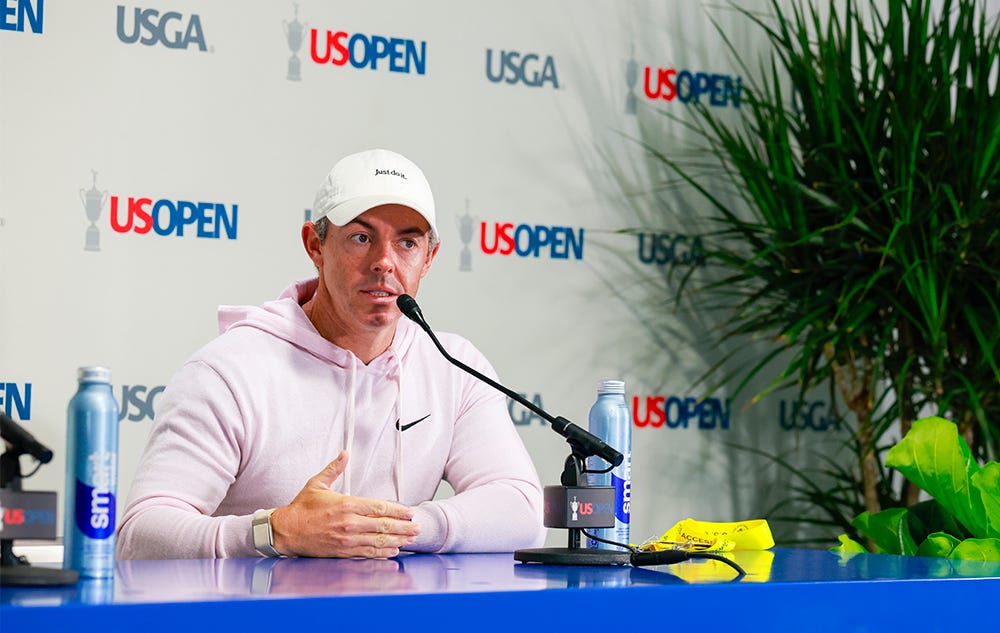
Rory McIlroy’s thoughts on new format won’t make PGA Tour happy (Jason E. Miczek/USGA)
Tour’s ‘old ways … weren’t actually that bad’
SOUTHAMPTON, N.Y. — Rory McIlroy said out loud Tuesday what undoubtedly many have been thinking: the PGA Tour’s planned two-tiered schedule has some rough edges that make it hard to swallow.
Or — as McIlroy more bluntly put it — the Track 2 tournaments are “a glorified Korn Ferry Tour event.”
McIlroy also added that the tour’s setup prior to LIV Golf shaking things up was “actually pretty good.”
Ouch.
Give McIlroy credit for speaking his mind ahead of the U.S. Open and just a week before PGA Tour CEO is scheduled to release more details about the future format of the tour at next week’s Travelers Championship.
McIlroy’s opinion is sought after and he’s rarely hesitant to share it, even if in this case it surely is not popular at PGA Tour headquarters.
McIlroy met with the media for a pre-tournament news conference in advance of the U.S. Open at Shinnecock Hills. He fielded 11 questions, most of them about the golf course (and one about his take on Scotland’s victory in the World Cup) before a seemingly innocuous one to end to end the session.
With Rolapp set to give some clarity to the new model next week the day after a PGA Tour Policy Board meeting, McIlroy was asked if he had any concerns about the new arrangement.
“An event like last week, the Canadian Open, potentially going to one of these Track 2s … Track 2 is a glorified Korn Ferry event,” said McIlroy, referring to the PGA Tour’s developmental circuit. “That’s what Track 2 is going to be. So I don’t think the Canadian Open should be one of those.
“I just think there’s going to be certain events that might lose their stature if a sponsor doesn’t pony up $30 million. So that’s the tough thing.”
Well, yes it is. McIlroy kind of covered the big points rather succinctly.
The schedule overhaul is part of a vague plan that Rolapp revealed at the Players Championship in March and again to reporters two weeks ago at the Memorial Tournament.
The basic outline would see there be approximately 16 Track 1 events in addition to the four major championships, the Players Championship and three playoff events for a total of about 24 tournaments.
There would also be in the neighborhood of 16 to 18 Track 2 events, some of which would be play in weeks between Track 1 events while some might be played the same weeks as the top-tier events (sort of like opposite events now) plus the fall schedule.
The bigger tournaments would have $20 million purses but the smaller ones could be less than a regular event now, perhaps in the $6 to $8 million range. Field sizes would range from 120 to 140 players, but it appears the leadership is leaning toward players being slotted into a respective Track for the entirety of the year with the ability to play your way up or down.
“I think what we have found as we’ve talked to sponsors both for Track 1 and Track 2, there’s a lot of demand for both,” Rolapp said. “And the price points will be different. The bigger events … not everyone can afford and may not be sort of consistent with their business goals. That’s great. There’s other price points, too, for it, and I think there’s plenty of demand for both Track 1 and Track 2 in that regard because there’s definitely people who want to invest different amounts in these events.”
But as McIlroy pointed out, will a long-time iconic national open such as the Canadian going to be a Track 2 tournament if sponsor RBC doesn’t want to dig deep for the sponsorship money to make it Track 1? RBC already sponsors the Heritage, a signature event in Hilton Head Island that follows the Masters. That, in theory, would remain a Track 1 event.
What about other local events that might be favorites of players? Scottie Scheffler and Jordan Spieth are both supporters for hometown Texas events like the Byron Nelson and Colonial. If either or neither is on Track 1, will they be allowed to play in them?
The prevailing view is no, because that would take them away from a Track 1 event for which sponsors are paying a premium.
All of this is in response to the PGA Tour going to a for-profit model two years ago, getting $1.5 billion in investment from Strategic Sports Group, giving players equity shares in the business and seeking ways to bring a return back to them in the form of revenue.
All of which would be achieved with a streamlined schedule, a better competitive model (a re-work of FedEx points system) and, perhaps, a more robust media rights package.
The PGA Tour went to the signature-event model in 2023 in part as a response to LIV Golf. Five of the eight signature events do not have a 36-hole cut, and thus it is guaranteed money for those who make the fields and choose to play.
But with LIV’s future in doubt in the aftermath of the Public Investment Fund pulling its funding after this year, many have taken pause. McIlroy’s Canadian Open example is an apt one. So, too, for the Texas-based events or perhaps ones at Torrey Pines and Palm Springs in California.
“Yeah, it’s funny. Like I think, as they’ve done all this work, you start to realize that the way the tour was before LIV came along was actually pretty good,” McIlroy said. “It was a pretty good structure, and everything sort of worked pretty well.
“LIV created this false economy where we had to up prize funds and had to cut fields and try to support the top players and all that stuff, which I think needed to happen because that was the only way to retain talent at the time. But now that LIV looks like it’s less of a threat, I think, as I said, the old ways of the PGA Tour weren’t actually that bad.”
It’s a new world, however. Gone is the non-profit narrative that saw the PGA Tour tout its work on behalf of charity.
Now that charitable return goes to the players and the investors. Pleasing them was never going to be easy. McIlroy made that very clear.
Selected Thursday U.S. Open tee times (* means 10th tee start)
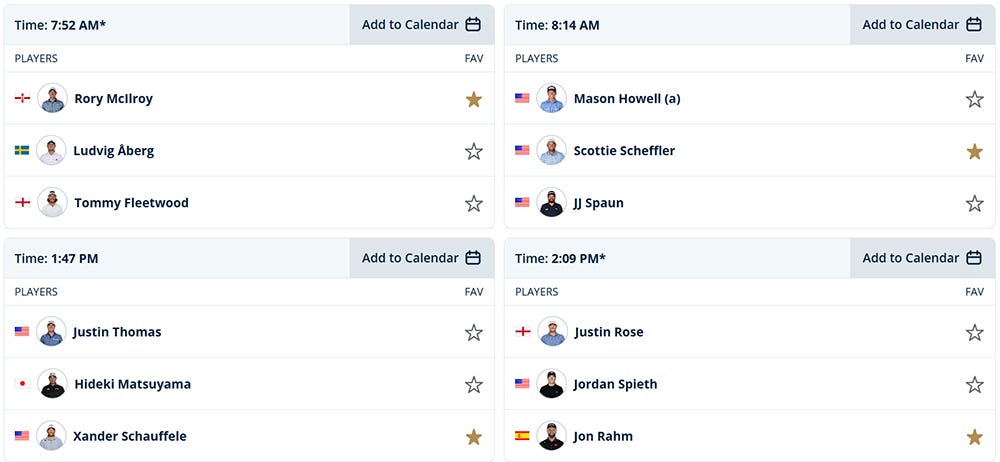
Click here for full U.S. Open tee times for first round on Thursday
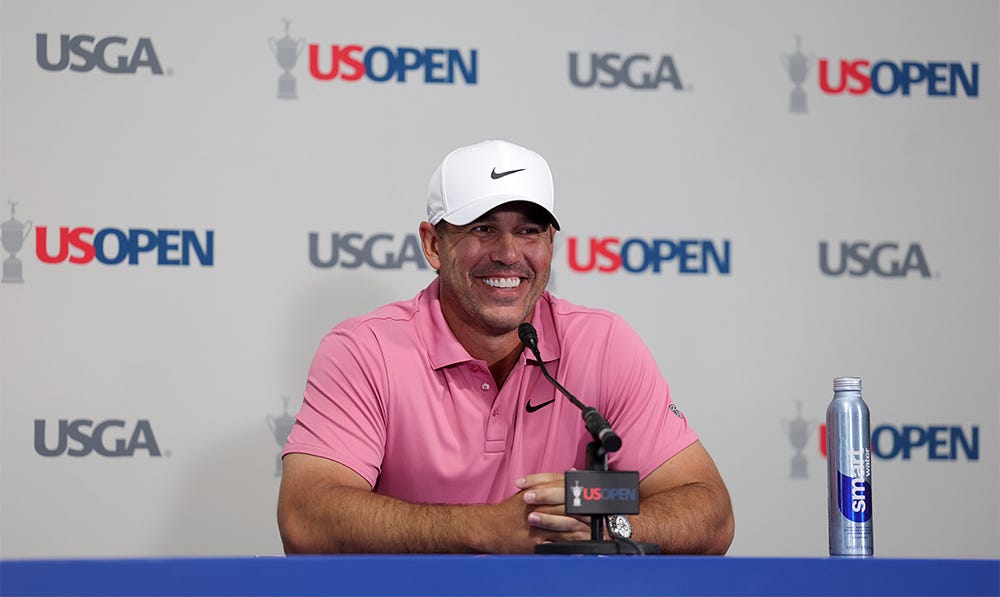
Two-time U.S. Open champion Brooks Koepka is encouraged after practice nine (Kate McShane/Getty Images)
Koepka’s health shows positive signs
Brooks Koepka played nine holes on Tuesday at Shinnecock and reported his hand felt better and that he wouldn’t have played if there had not been improvement. Still, that serves as a bit of a mixed message with the tournament approaching on Thursday.
