


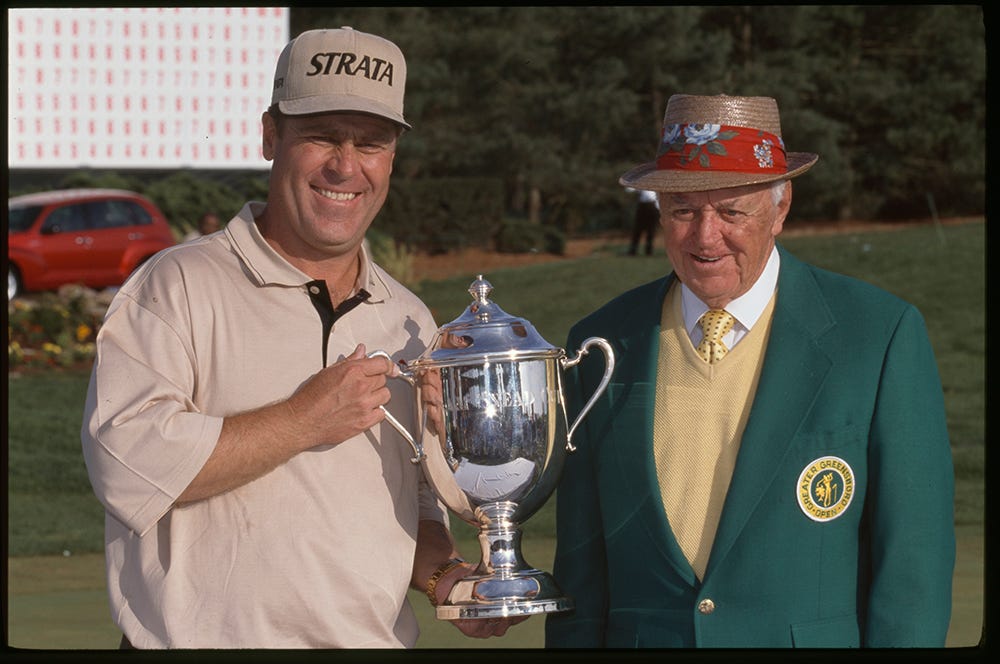
Hal Sutton received the Sam Snead Trophy in 2000 from Snead himself (Stan Badz/PGA Tour Archive via Getty Images)
Bigger purses, bigger markets, bigger exposure and potentially bigger media rights revenue. That’s what the future PGA Tour model promises.
But is bigger always better?
Not necessarily, as several events on the PGA Tour schedule have proven over the years.
The new two-tier PGA Tour model set to be unveiled in 2028 promises plenty of positives for players and fans in the marquee Championship Series.
But, undoubtedly, there will be some pain. Some longstanding events will either be relegated to the PGA Tour’s secondary Challenger Series tier or perhaps go disappear altogether. It’s an inevitable aspect of making big changes.
Events such as the American Express Championship in Palm Springs, Calif. (the former Bob Hope Desert Classic), the Cognizant Classic (formerly Honda) at PGA National and the Valspar Championship in Innisbrook in Florida, the Byron Nelson in Texas, the John Deere Classic in the midwest’s Quad Cities … those are some tournaments with long histories whose futures are currently in doubt.
Add the Wyndham Championship to the list.
Also in today’s DD …
Peter Kaufman sizes up limited details of LIV investment agreement
This week’s tournament at Sedgefield Country Club in Greensboro, N.C. — the last regular-season event on the PGA Tour schedule — has been around for 88 years since it started as the Greater Greensboro Open back in 1938 — four years after the Masters began. For the 20 years of the FedEx Cup playoffs, it has made due with a difficult date and still thrived.
How it looks in a new-world PGA Tour is still to be decided but there appears to be significant support for the event to get one of the top tier spots being called the Championship Series.
“From my perspective, we have been working hard on trying to be relevant and do something special for this region,” said Mark Brazil, the executive tournament director. “There is a lot of history here. There’s a lot of history at Sedgefield. We want to stay in the game. But nothing’s been determined yet. We are going to put our head down and work with the tour.
“From a business perspective and being in the golf industry for 33 years, I appreciate what they are doing,” Brazil added. “I think Brian (Rolapp, the tour’s CEO) is onto something here. We’re doing everything to stay in the game.”
Apparently willing to help iis stay in the game is the state of North Carolina, which recently saw its senate approve a bill that would target $40 million toward the tournament to be spread over four years — as long it is a Championship Series event, according to the Triad Business Journal.
That would help the event bridge the gap with a new title sponsor, as Wyndham’s deal is up after next year. Title sponsorship of these Championship Series events is running in the $30 million range.
Greensboro has a long and storied history with the PGA Tour. For years, the tournament was played in the spring, sometimes leading up to the Masters and sometimes two weeks after the season’s first major. Sam Snead won the first event in 1938 and won it for an eighth time in 1965, which came at age 52 and made him the oldest at the time to win a PGA Tour event. He was such an inttegral part of teh tournament that the trophy is named after name.
Sixteen Masters champions from Snead, Ben Hogan, Byron Nelson, Gary Player and Raymond Floyd to Seve Ballesteros, Sandy Lyle, Sergio Garcia and Patrick Reed are on Greensboro’s roster of champions. In all, 34 past Greensboro champions accounting for more than half of the tournaments played are major winners including Tom Weiskopf, Lanny Wadkins, Hal Sutton, Henrik Stenson and Davis Love III — who won the tournament for the third time at age 51 in 2015. The last three Wyndham champions are Lucas Glover, Aaron Rai and Cameron Young.
It was also in Greensboro where in 1961 Charlie Sifford ecame the first Black golfer permitted to play in a PGA-sponsored event in the South. He led after the first round and tied for fourth.
Another twist to Greensboro’s bid to survive on the Championship Series: it would be unlikely to be the last regular season event as it has been for 20 years. There is talk of moving it back to the spring as part of a Carolinas swing between the Masters and PGA Championship that could include the RBC Heritage in Hitlon Head, S.C., and the Truist Championship in Charlotte, N.C.
Brazil was unable to discuss any of those possibilities, but he’s had plenty of experience with the challenges associated with running the event in a smaller market like Greensboro.
“I think moving over here to Sedgefield (in 2007) was the right call,” he said of the shift back to the classic Donald Ross course after a long stint at the more modern Forest Oaks Country Club. “At the end of the day, we’ve gotten a lot of help out of the evolution of the tournament that it has become.
“Besides the (Carolina) Hurricanes (NHL team, which just won the Stanley Cup) and an ATP (tennis) event in Winston-Salem, this is really the biggest annual sporting event in our region. It would be a huge deal if we could take it to another level.”
When Rolapp in March first discussed the two-tier plan, he was asked a question that harkened to his previous tenure in the NFL — is there room on the PGA Tour schedule for “the Green Bay Packers and Jacksonville Jaguars.” The reference was to smaller-market NFL teams that would be comparable to some of the PGA Tour’s thriving small-market events.
“I think just because we are looking to play more often in bigger markets does not necessarily mean we’re abandoning small markets,” Rolapp said. “That is a misconception. There are room for both, to your point, which is I think the point with your Green Bay Packers analogy.”
It appears there may still be room for Greensboro.
Stray Shot analysis of LIV Golf’s investor ‘reveal’
LIV Golf CEO Scott O’Neil revealed Wednesday at LIV Golf New York that he has secured investment for the league to continue on past 2026. He’s been scrambling for funding since the Public Investment Fund of Saudi Arabia announced in April that it would be withdrawing its support after this year. Peter Kaufman, who writes Stray Shots weekly for the Daily Drive, attempted to unpack some of the information that was disclosed.
