

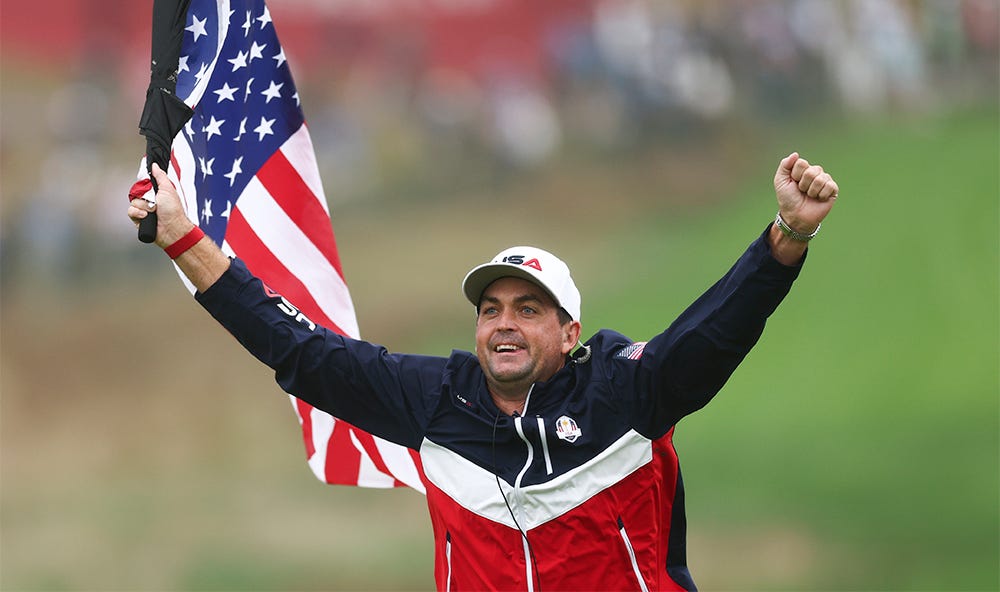
U.S. flag waver Keegan Bradley admits “this effing event has been so brutal to me.” (Maddie Meyer/PGA of America)
What is the future of the Ryder Cup? More pointedly, what is the future of the U.S. Ryder Cup team?
Let’s start with the numbers.
Over the last 12 matches, the U.S. has won three times, which means the Europeans have captured nine.
In that 12-match period, the Europeans have won three times in the U.S., and the Americans have not won a single time in Europe.
What else do you need to know?
Curtis Strange, Hal Sutton, Tom Lehman, Corey Pavin, Davis Love III, Tom Watson, Jim Furyk, Zach Johnson and Keegan Bradley are all American captains who have not found the winner’s circle.
The point total over the 12 matches: Europe 178.5, U.S. 157.5 — a 21-point differential.
I could go on, but if you don’t get the point, then maybe you should be the next U.S. Ryder Cup captain.
So, if you are America — or in this case, the PGA of America — what do you do?
The last time the U.S. found itself in a similar situation (the 14.5-13.5 defeat at Medinah Country Club in 2012) PGA of America president Ted Bishop took the unusual step of flying to Kansas City to persuade Tom Watson to take the captain’s job.
Watson was seen as an unusual selection, due to his age and lack of relationship to the players, but the goal was to shake things up.
Ultimately, it didn’t work. Europe thrashed the Americans 16.5-11.5 defeat at Gleneagles, prompting a calling out by team members that led to the PGA of America creating the Task Force.
Players and luminaries from the PGA of America got together to come up with a solution. With winning being the goal and measure for success, the U.S. achieved some value by winning two of the next five matches, but none on foreign soil.
And with the abysmal performance in the first two days at Bethpage Black, it seems clear the Task Force blueprint is no longer the answer.
The next U.S. captain in Ireland will be Tiger Woods, if he wants the job. If he doesn’t, the door will be wide open.
Bradley was probably too young, mainly because his game was good enough to make his own team. While the discussion of a playing captain was bandied about, ultimately Bradley stuck to his guns and didn’t play.
He has taken the defeat hard, saying “this effing event has been so brutal to me.”
“Since Bethpage, this has been one of the toughest times in my life,” said Bradley in his first news conference this week since the event. “You win, it’s glory for a lifetime — but I didn’t and I’m going to have to sit with this for the rest of my life.
“There’s no part of me that thinks I’ll ever get over this. This event has been so brutal to me. I’ll forever wonder and wish.
“You put so much into it, and you have all this planning, and the first two days went as poorly as we could have ever thought. It was pretty emotional. It was sad, to be honest.”
The playing captain option weighed hard on Bradley right up until Ryder Cup week.
“In the history of the game — back to Bobby Jones, Tiger Woods, Jack Nicklaus — I don’t know if any of them got to experience what I experienced this year. I got to experience something in the game of golf that I don’t think anyone’s ever experienced: where I’m the Ryder Cup captain but also competing at a very high level, and winning tournaments, and contending in tournaments. And it was really incredible.
“The first practice day, I was out on the tee, and I was watching the guys walk down the fairway all together, and I said to myself, ‘I wish I was playing. That’s what it’s all about. I’m missing out.’
“By the second or third day I was like it’s a good thing I’m not playing because I was so physically exhausted. … Good thing I didn’t do it because it would have been bad.
“I just didn’t think I could do both jobs.”
The next captain, whether it’s Woods or someone else, should no longer be a player who can compete on the PGA Tour. They can play on PGA Tour, but not be so competitive that the discussion of playing captain arises.
Also, if we’ve learned anything from Europe, it’s that we need vice captains who have been successful in the matches. European captain Luke Donald had Thomas Bjørn, José María Olazábal and Paul McGinley in the wings. That’s three captains who have won Ryder Cups, plus Edoardo Molinari, the stats guru whom Donald trusted implicitly.
Molinari is, in many ways, the key. He competes at a high level on the DP World Tour and offers statistical guidance to both men and women on tours worldwide.
The Italian’s analysis is not just about black and white numbers; it involves relationships with the players and plays the game at a high level.
The U.S. has people who provide stats, but it’s just not the same.
I think the best way to illustrate that point is that the morning session of the last two Ryder Cups, foursomes (a.k.a. alternate shot) was 7-1 in favor of the Europeans. It’s those pairings where analytics are most relied upon.
As the matches go on, players’ performance becomes more of a measure of how they play in the other sessions, and analytics take a back seat.
But the selection process, along with the first and second sessions on Friday, is where analytics make the most significant difference.
As you start to peel back the onion on the U.S. performance, not just at Bethpage Black but over the last 23 years, the answers are small, but they are there.
Some aspects have nothing to do with the players and are more about putting them in the best position to succeed. There is a reasonable argument that it has not happened enough.
Two former captains who should have received a phone call by now: Paul Azinger and Steve Stricker, both winning captains. Looking back on their captaincies could shed some light on what a future U.S. team should do differently.
Again, it’s just crumbs or pieces of a vast jigsaw puzzle, but if the U.S. is going to take back the cup in Ireland in two years, that type of forensic analysis is required.
The analysis should be done independently, without any current players or PGA of America staff.
The U.S. may have a game plan to work off of, like the Europeans have done successfully.
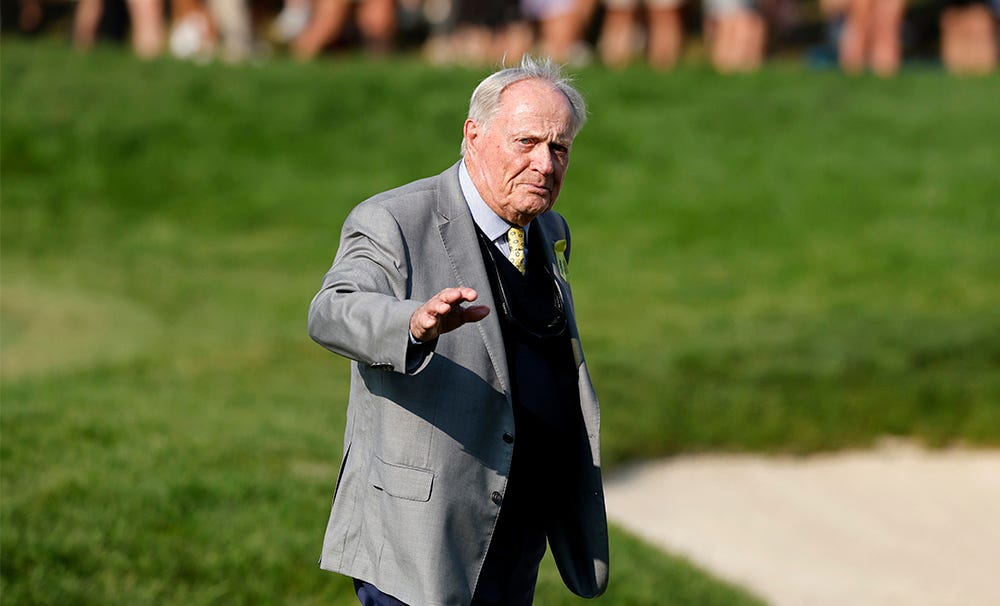
Jack Nicklaus won big in court against his former company partners (Joe Robbins/Icon Sportswire via Getty Images)
Stray Shots: Nicklaus adds to career win total
By Peter Kaufman
1. The GOAT wins 19th major: Jack Nicklaus won a $50 million judgement in a defamation lawsuit filed in Florida against his former business partners — Nicklaus Companies owner and executive chairman Howard Milstein and executive Andrew O’Brien. The defamation suit claimed Milstein, O’Brien and others at the company spread false stories that Nicklaus considered a $750 million deal to join the Saudi Arabia-backed LIV Golf and that he was suffering from dementia and no longer mentally fit to manage his affairs.
The jury needed only four hours to side with Nicklaus and awarded the company that bears his name to pay him $50 million in damages.
There is a lot to unpack here.
2. Doomed marriage: The marriage between Nicklaus and Milstein was doomed at the start. It’s pretty much impossible to find less likely bedfellows than the Teutonic midwestern Jack and the New York City real estate/banking/hotel magnate whose family fortune has been estimated at over $5 billion.
3. Money ball: As it turns out, and assuming payment of the judgment is made, Nicklaus will have received a total of about $230 million since 2007. ($145 million in 2007 sale proceeds, a believed $30-40 million more a few years thereafter and now the $50 million judgment).
4. Business context: Not too shabby for a guy who admits his business ventures heretofore were not exactly pillars of success (several real estate investments which were difficult, fraud at his company, etc.). As a matter of fact, his 1986 Masters win was very needed and timely in light of a couple of his projects at the time, as it returned the then 46-year Jack to prominence, which in turn helped him weather the business storms.
His course design business has been thriving over the past period of time.
5. Partnership context: By all third-party accounts, Nicklaus worked tirelessly for many years after the 2007 transaction designing courses and did so in the face of some challenging dynamics with his partners. Milstein, for example, took away Jack’s use of the company plane, which feels like much more of a control move than a fiscal prudence move.
6. Litigious partner: The Milstein family is known for being litigious. They sue others, they sue intrafamily and, among other ramifications, their penchant to resort to the courts, it has been reported, caused NFL owners to not be warm to their franchise ownership goals some years ago.
7. Curious defense: At trial, the Milstein attorneys basically kissed Jack on all cheeks, describing him as a pillar of American sports and basically acknowledged that even at 85, he remains “the guy.” The purpose of this approach, of course, was to try to persuade the jury that no damage to Jack’s rep had occurred here even if they were found to have made false claims about their company namesake.
8. Damages? What damages? Let’s be clear: do you think less of Jack after the Milstein defamatory comments? Me neither. So the $50 million seems utterly arbitrary. Perhaps a better message that the trier of fact could have sent was “the comments were defamatory and the Milsteins should pay Jack’s legal fees plus $1 for damages.” But it’s not what happened.
9. Next steps: Will the Nicklaus Company post a big bond and appeal the verdict, or will it pay the $50 million and cut their pecuniary and reputational losses and just make it all go away now, finally?
10. Jack’s cumulative legal wins: Nicklaus had previously won the right, in the past couple years, to use his own name in designing courses, over Milstein’s objections. And now this. So on the legal front, Jack has basically shot 66 from the tips while Team Milstein has stumbled to a 91 from the forward tees when it came to the break-up of their corporate marriage.
The lawsuits have weighed heavily on Nicklaus. I interviewed him in 2022 about Doug Sanders and the 1970 Open Championship at a time when he was simply not speaking to the press so as to avoid unwanted publicity about the lawsuits. He made an exception for SI — because he really wanted to talk about Sanders.
He was incredibly gracious, and quite loquacious about Sanders and the Open playoff at St. Andrews, but his gatekeepers required that nothing be asked about the Milstein contretemps, and that was honored.
Here is hoping that Nicklaus can put the Milstein litigation in his rear-view, permanently. He has his name back — and judicial confirmation of who was right and wrong in the contretemps with Milstein — to pursue whatever he likes on the finishing holes of his life.