


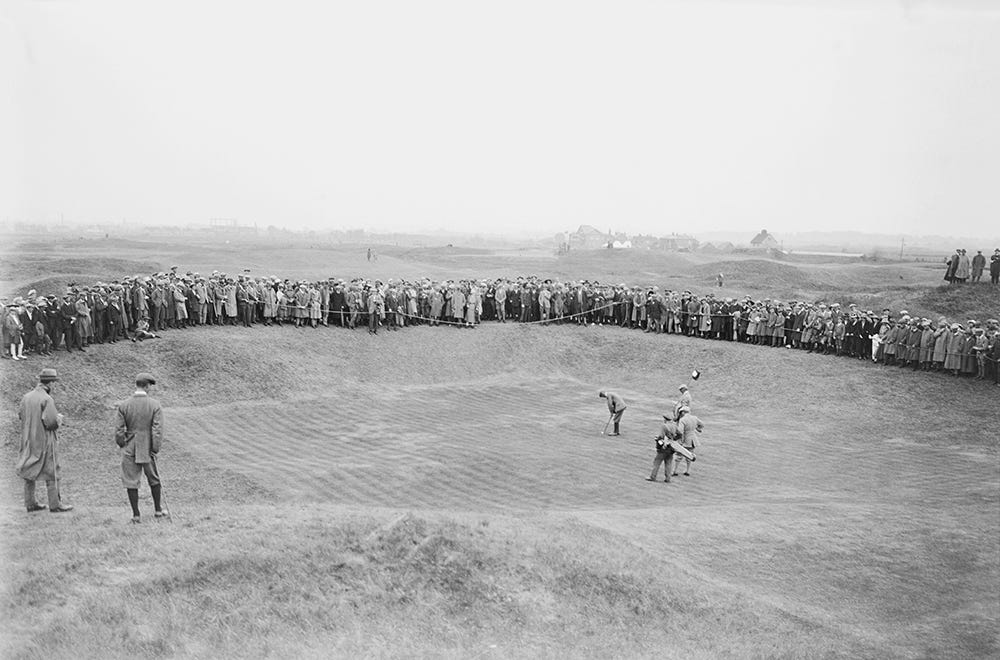
Abe Mitchell held 6-stroke lead halfway through 1920 Open at Deal (Topical Press Agency/Hulton Archive/Getty Images)
While we all process what happened on Saturday at Augusta National before the co-leaders tee off in the final round of the 90th Masters, it seems like a good time to become acquainted with Abe Mitchell.
There is little reason for even the most avid modern golf fan to know of Mitchell, who is often first described as “the illegitimate son of Mary Mitchell” born in East Grinstead, England in 1887 and, according to five-time Open champion J.H. Taylor, was the original “greatest player to never win a major.”
We all, however, are familiar with his likeness, as Mitchell is immortalized atop the Ryder Cup.
You see, Mitchell was supposed to serve as the player-captain in the inaugural Ryder Cup matches in 1927 at Worcester Country Club in Massachusetts, but the personal golf instructor of Samuel Ryder was unable to make the trans-Atlantic journey due to either a bout of appendicitis or anxiety he was known to suffer from after serving on the front line in World War I.
Mitchell did play in three subsequent Ryder Cups (1929, ’31 and ’33), helping the team from Great Britain actually defeat the U.S. team twice on home soil at Moortown in Leeds and Southport & Ainsdale.
As thanks for teaching him the game in St. Albans north of London, Samuel Ryder had Mitchell’s figure placed atop the 17-inch cup he donated to the competition that bears his name. “I owe golf a great deal,” Mitchell said. “What you have done, putting me on top of the cup, is more distinction than I could ever earn.”
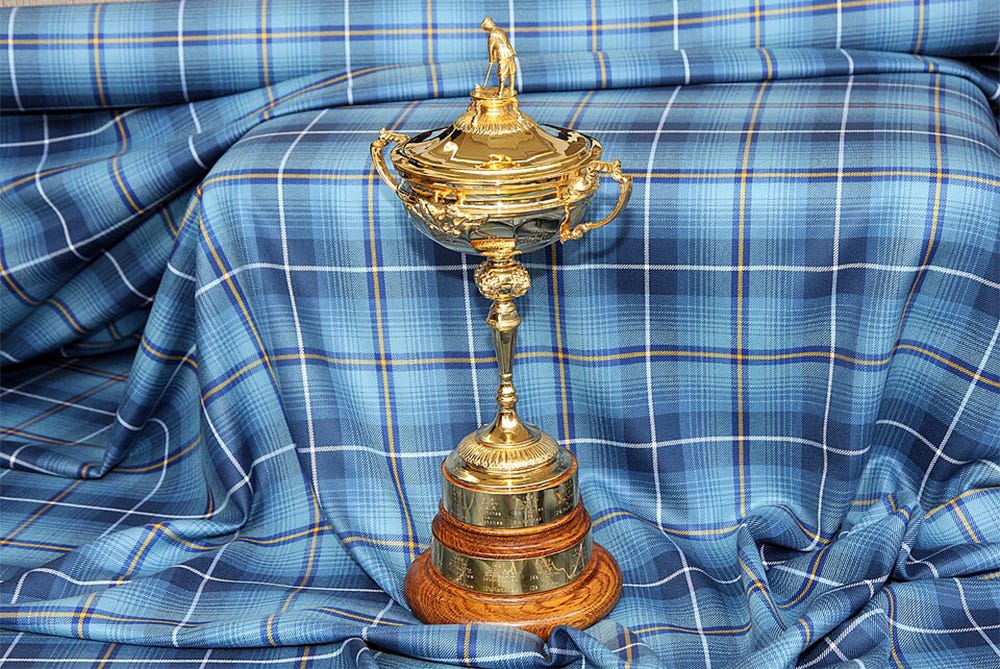
Figure atop the Ryder Cup is a likeness of Abe Mitchell (Wikipedia photo)
While Mitchell finished runner-up in the 1912 British Amateur, 17th in the 1922 U.S. Open and fourth three times in the Open Championship, there is one other distinction that is the reason for writing this remembrance today.
Mitchell is the only player in the history of the game to blow a six-stroke or better lead after 36 holes in a major championship. A year after joining golf’s most exclusive fraternity as a career grand slam winner, this is one historical accomplishment Rory McIlroy would not like to pull off.
McIlroy soared to a record six-shot lead on Friday at the midpoint of the 90th Masters. That tied him with himself (among others) for the third largest 36-hole lead in major history, behind only Henry Cotton’s nine-shot gap in the 1934 British Open at Royal St. George’s and Brooks Koepka’s seven-shot margin in the 2019 PGA Championship at Bethpage Black. Also with six-stroke 36-hole leads were Martin Kaymer in the 2014 U.S. Open at Pinehurst, McIlroy in the 2011 U.S. Open at Congressional, Tiger Woods in the 2000 U.S. Open at Pebble Beach and Mitchell in the 1920 Open at Royal Cinque Ports (Deal).
Everyone before — except Mitchell — went on to victory.
Deal was supposed the host the 1915 Open Championship, but the outbreak of the Great War forced it to be cancelled. So when the British Open resumed in 1920, it went back to Royal Cinque Ports.
Mitchell, an amateur, led all qualifiers as medalist to get into the field of 74 players. Rounds of 74 and 73 saw Mitchell open a six-shot lead over Jim Barnes and Sandy Herd.
Mitchell’s third round, however, was disastrous. He started with three bogeys, made a seven at the fifth hole and finished with an 84 to fall into a tie for fourth with George Duncan two shots behind 54-hole leader Len Holland. Duncan, who’d started with a pair of 80s, shot 72 in the final round to win the claret jug and Mitchell settled for fourth.
Now Mitchell has a chance to be remembered in the same context as McIlroy, whose six-shot lead evaporated on the lowest scoring third-round Saturday in Masters history.
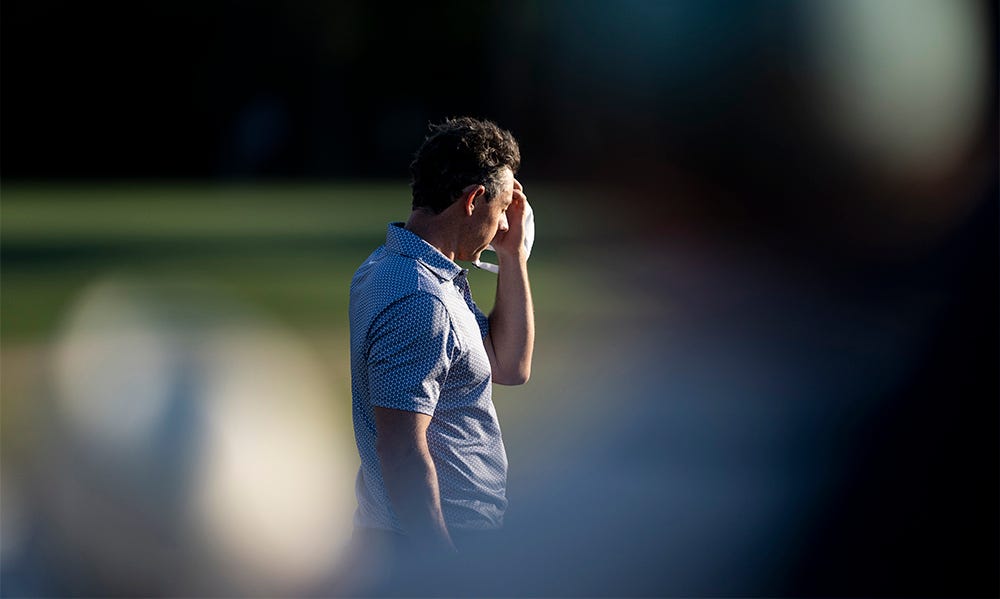
Rory McIlroy scratches his head after 6-shot lead dissolved in a long third round at Masters (Leckie Wong/ANGC)
While guys like Cam Young and Scottie Scheffler were posting 65s and the scoring average (70.63) dipped below 71 strokes for only the third time in Masters history, McIlroy shot 73 and ended the day tied with Young for the lead at 11-under. Now it’s a horse race on Sunday with 11 players within five shots of the lead.
A potential date with infamy awaits McIlroy at Augusta late Sunday. Either he joins another exclusive fraternity with Jack Nicklaus, Nick Faldo and Tiger Woods as the only players to ever win back-to-back green jackets, or his joins Abe Mitchell as the only players to ever lose a six-shot 36-hole lead in a major championship.
If Rory doesn’t turn his fortunes back around, he will never be able to look at the figure on top of the Ryder Cup quite the same way.