


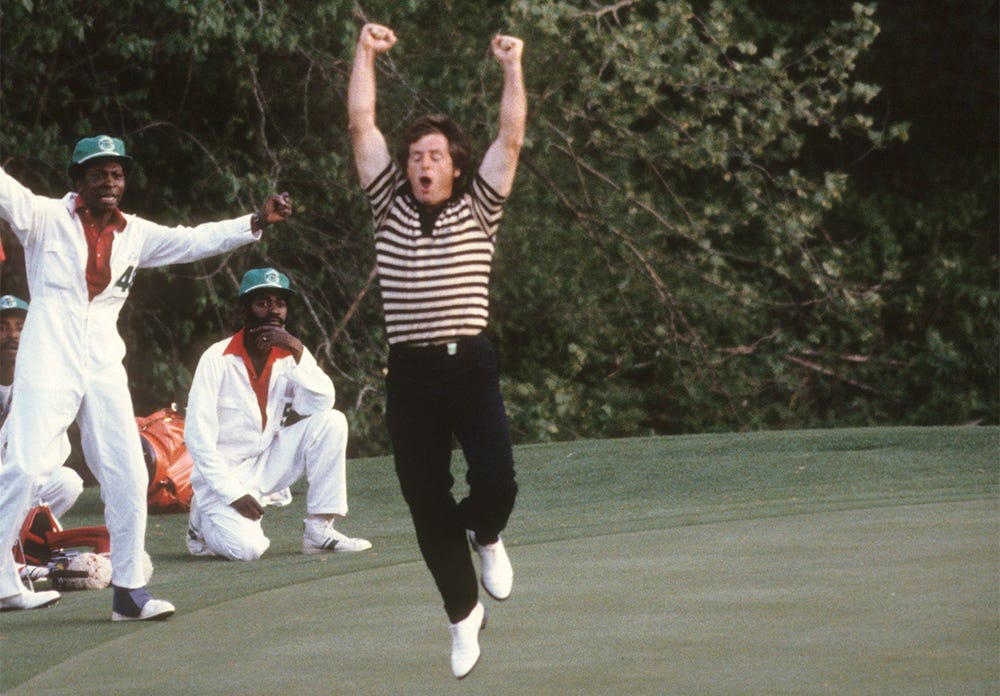
Fuzzy Zoeller and caddie Jeriah Beard celebrate 1979 Masters win (John Iacono /Sports Illustrated via Getty Images)
We all deserve to be remembered for more than our weakest moment. Frank Urban Zoeller Jr. — who died on Thanksgiving Day at age 74 — certainly deserves more than being remembered for a regrettably delivered quip.
Fuzzy Zoeller was an underrated golfer, a two-time major champion who could whistle his drives past his competitors while whistling his way down the fairway as well. He mentored John Daly, befriended Vijay Singh, was close with Hubert Green, outdueled legends and didn’t shy away from the 19th hole.
He remains the only player since the first and second editions of Augusta National’s tournament in 1934 and ’35 to win the Masters in his first attempt, which he delivered in the inaugural sudden-death playoff in 1979. He laid waste to Greg Norman in another major championship playoff to win the 1984 U.S. Open at Winged Foot. Fuzzy also charmed galleries with his quips and his good nature during a 10-victory PGA Tour career that was undoubtedly deprived of more trophies due to back issues.
Since his passing was reported last Thursday, no legitimate obituary failed to mention the controversy that haunted him — hurting his reputation and undoubtedly causing him financial and personal pain.
Zoeller’s weakest moment came after his final round at the 1997 Masters when he was asked about the dominant performance of Tiger Woods, who was on his way to a record 12-shot victory in his first major championship as a pro.
The interview took place near the famous tree outside of the Augusta National clubhouse, where Zoeller praised in front of a few writers and TV cameramen about the performance of the 21-year-old phenom who was re-writing the record book at Augusta National: “Pretty impressive. That little boy is driving it well, and he’s putting well. He’s doing everything it takes to win.”
His walkaway comment did not appear until the following Saturday on CNN, but it packed a powerful punch.
“So, you know what you guys do when he gets in here?” Zoeller said. “You pat him on the back and say congratulations and enjoy it and tell him not serve fried chicken next year. Got it?”
Zoeller was referring to the Masters champion’s dinner, where the defending champion traditionally picks the menu.
He then smiled and as he walked away turned and said, “Or collard greens or whatever the hell they serve.”
Those comments obviously caused considerable backlash.
Zoeller publicly apologized before withdrawing ahead the Kmart Greater Greensboro Open, where he was being honored as a loyal participant at the tournament for more than two decades that was hosted by his corporate sponsor. Kmart dropped his endorsement deal over the controversy, but his friends quickly came to his defense, saying Fuzzy was a fun-loving jokester and not a racist.
All of that is likely true.
But those were some biting words at Augusta. And the fact that Woods let him twist for a few days before acknowledging the apology is proof that the comments stung.
Woods, who grew up in Southern California in a middle class family, may not have even understood what all the fuss was about, although he dealt with his share of racism in his youth. But his father, Earl, certainly did. And he no doubt played a role in his son’s reaction.
Zoeller used a racist trope on a day when the black clubhouse staff at Augusta National stood on the balcony to bear witness Tiger’s historic victory. In today’s political rhetoric, comments like that get forgotten in one news cycle. Sergio Garcia made a “fried chicken” reference in relation to Woods in 2013 and largely escaped rebuke, although the angst between the two players didn’t help that situation.
But Zoeller’s mistake clung to him. What made his comment so offensive was the damning condescension of “whatever the hell they serve.”
Zoeller lost a major endorsement deal with Kmart over the flap and felt the public ire despite his many efforts to make amends.
In a 2008 Golf Digest interview, Zoeller said: “I’ve cried many times. I’ve apologized countless times for words said in jest that just aren’t a reflection of who I am. I have hundreds of friends, including people of color, who will attest to that. Still, I’ve come to terms with the fact that this incident will never, ever go away.”
Michael Bamberger from Golf.com dove into Zoeller’s complicated legacy in an excellent piece that explains in detail all that emerged. Bamberber also wrote: “Here is a list of the three greatest modern-era natural golf talents in American professional golf: John Daly; Fred Couples; Fuzzy Zoeller. (Zoeller) had Hall of Fame talent, but the good life, Fuzzy style, was always pulling at him. Hunting, fishing, a long series of soggy red-meat dinners, the ashtrays crowded by last call.”
Zoeller played his 31st and final Masters in 2009, three decades after his epic 1979 victory in which he defeated Ed Sneed and Tom Watson in the first sudden-death playoff at Augusta which reached the 11th green, where he made a walk-off birdie.
After that victory and for years afterward, Zoeller praised the work of his Augusta caddie, Jeriah “Bubba” Beard, who he said guided him around the course in an era before yardage or green books. Beard (who died in 2023) had caddied in 20 Masters before he picked up Zoeller’s bag the Sunday before Masters week in 1979, and by the end of their first nine holes together Fuzzy had already gained faith in Beard’s ability to pull his clubs and read the greens.
“He told me what to do and I did it,” was Zoeller’s recollection 40 years later in 2019.
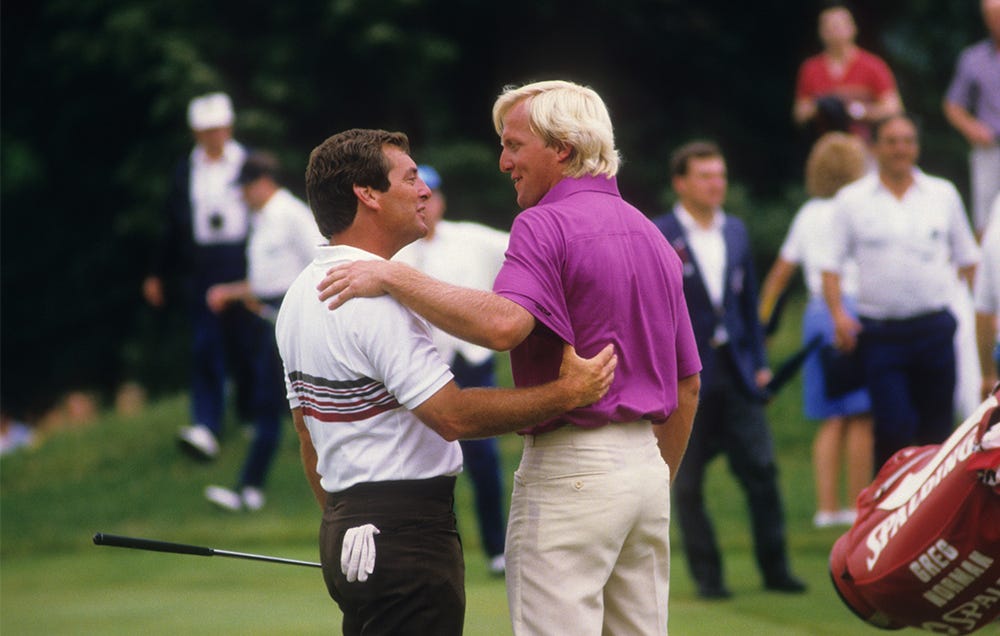
Greg Norman surrendered to Zoeller in 1984 U.S. Open playoff (John Iacono /Sports Illustrated via Getty Images)
In 1984 at Winged Foot, Zoeller famously waved a white towel from the 18th fairway believing the long putt that Norman holed on the green ahead of him was to win. Instead, it forced a tie and the two played an 18-hole playoff the next day. Zoeller won that head-to-head playoff by eight shots and it was Norman who stood in the 18th fairway and handed Zoeller a white towel of surrender.
Fuzzy would go on to win a total of 10 times on the PGA Tour as well as two PGA Tour Champions victories. He also finished runner-up in the 1981 PGA Championship at Atlanta Athletic Club to Larry Nelson and third behind champion Nick Price in the 1994 British Open at Turnberry after holding the 54-hole lead.
It is perhaps poetic that Zoeller died on Thanksgiving Day when the Skins Game was being reprised by a new generation. Zoeller was a frequent and popular participant in the 1980’s heyday of the Skins Game, more than holding his own against golf’s legends.
“No player could have had a better temperament for Skins Game golf than Fuzzy,” wrote Bamberger. “He was loose, he was funny, he was fast and, when he was on, he could stake shots and hole putts with anybody. He won the Thanksgiving made-for-TV golf ritual in 1985 (Tom Watson was second), won it again in ’86 (Lee Trevino was second) and finished second (with Jack Nicklaus) when Trevino won the most Skins money in ’87.”
Fuzzy Zoeller should be remembered as one of golf’s legends himself, a great player and one of the game’s all-time great characters who possessed more character than what his regrettably weakest moment might indicate.
And yet, you too write about the incident to further cement that legacy. I’m sure Fuzzy is happy about that!