


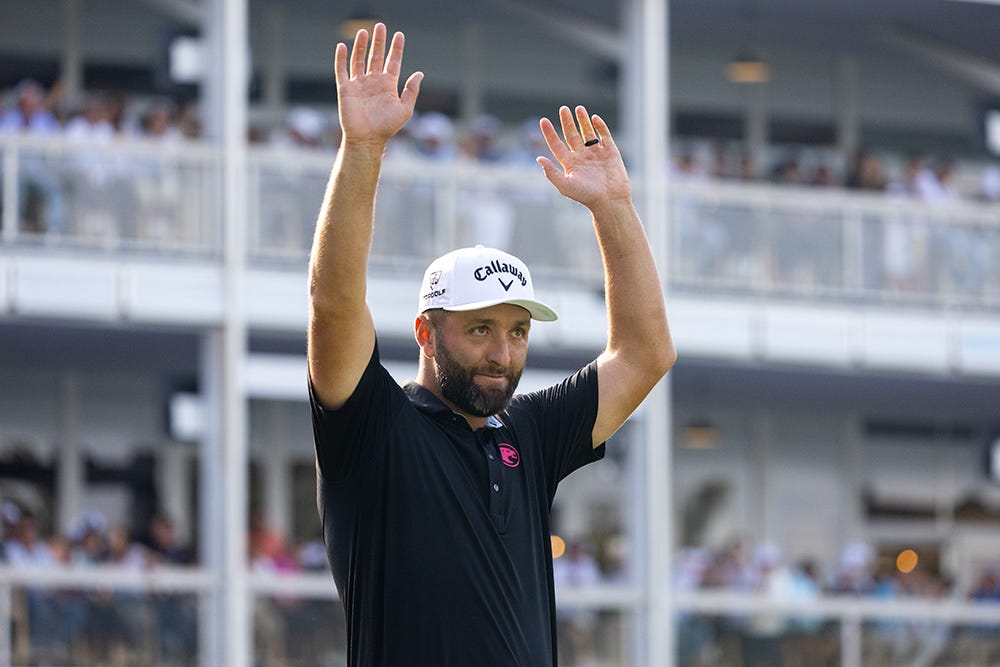
Did Jon Rahm get a parental guarantee from PIF, meaning it assures payment? (Jon Gerry/LIV Golf)
For those who love the PGA Tour, this emerging story is, well, delicious.
And for those who love LIV Golf? Well, it is not necessarily as dire as it appears, even if it all seems so remarkable given the massive pool of funding the league has enjoyed to date.
LIV Golf is, according to a Bloomberg News report, preparing to file for bankruptcy.
So let’s do a bit of a dive as to what means, and could mean, going forward.
First, “bankruptcy” is not a solution — it’s a place, a venue. It’s a place where companies can find, or implement, a financial solution to its capital structure problems. “Capital structure” means how to treat those who have loaned and invested money to date, and can include — as is likely here — liquidity challenges, specifically that LIV needs more money to continue operations in some fashion beyond 2026.
Three weeks ago, the Public Investment Fund of Saudi Arabia, which has backed LIV Golf since 2022 to the tune of some $5 billion, said it would no longer fund the league beyond this season.
Second, filing bankruptcy has some real advantages for a company in financial distress. Its creditors (lenders, landlords, etc) are prevented from taking legal action against the company for at least 180 days, and perhaps longer. That means LIV Golf can perhaps access fresh near-term capital to prime its operational pump (called debtor-in-possesion, or DIP, financing).
And LIV can then do a couple of important things in bankruptcy. Among other things it can:
reorganize its capital structure;
access long-term capital, called “exit financing” (new money to permit LIV to emerge from bankruptcy in a much stronger position);
shed liabilities;
sell its operations.
There are two ways to execute a sale:
Pursuant to a Plan of Reorganization (POR), which is a longer term process that wraps up everything (treatment of capital structure, new ownership, etc.) and requires votes of creditors and sometimes shareholders.
Through a “section 363” auction process, which is pretty much the opposite of a POR, which can take just 60-120 days and requires no votes. Money comes in and assets (sometimes stock) go out the door to a buyer, and it wraps up nothing else; the money sits there for all the creditors to fight over.
Right now, its investment bank should be seeking (DIP) financing, exit financing, and acquisition interest.
Acquisition interest could come in the form of LIV Golf itself, or in individual teams. All potential avenues should be pursued and considered on a fast-track basis. It may still be possible to transact out of bankruptcy court, but it’s rather likely any putative acquirer or financier will want to transact only under the auspices of a bankruptcy court.
That is because the “title” a buyer or financier receives in bankruptcy court is the cleanest title known to man — almost all liabilities, real or contingent (meaning they could be lurking out there and the buyer may not know about them), will be shed or addressed.
Conversely, if one transacts out of court and acquires the stock of LIV, then one also inherits all liabilities, actual and contingent. It’s generally okay if you are buying a healthy company, but not so advisable if it’s in distress, and LIV Golf would seemingly be in the latter category.
What are some interesting aspects to this situation? Top of the list are player contracts; those who have not yet received all their contractually promised money will be “creditors” of a bankrupt LIV, and will likely be deemed “unsecured” creditors (they cannot look to any LIV collateral for redress). They will be a lower priority than entities who loaned money but received an interest in LIV collateral (secured creditors).
Unless — were certain players (like potentially Jon Rahm) advised well enough to get a form of parental guarantee from PIF, meaning it assures payment regardless of PIF’s obligations to LIV Golf? If so, they will be in a different, and far better, bucket than those who only contracted at the LIV level.
And, its highly unlikely LIV will be paying player salaries upon a bankruptcy.
Let’s not forget the overhang here — who really wants to be going up against, in a public forum, PIF and the Saudis, a country whose human rights abuses have been quesitoned going well back before it chose to invest in a golf league.
The PGA Tour may or may not have a direct stake in these proceedings, but it certainly will at the least be a very interested buystander, both about the future (if any) of LIV, but also with respect to the LIV players and their future.
The PGA Tour could certainly be a potential investor/acquirer of LIV — wasn’t that what the framework agrement of three years ago was supposed to be about? — and would control it and shape it to the desires of the tour. Or it could acquire LIV just to disband it, perhaps something that was discussed in negotations with the PIF previously. Or to make it an operating subsidiary. Acquiring the intellectual property (name and brand) is one way to do it.
But the PGA Tour will also likely tread carefully here, given the prior specter of antitrust allegations/investigation and litigation flowing from LIV lawsuit — since dismissed after making the framework agreement.
Stay tuned to this developing story.
