


The Daily Drive will be taking the rest of the long weekend off for the Fourth of July holiday. We’ll resume publishing on Monday, July 6. Happy 250th America.
In today’s DD …
Whither long-time events like the John Deere in two-tiered tour
Daily Drive podcast on the business of LIV Golf
Winners & losers in Open Final Qualifying
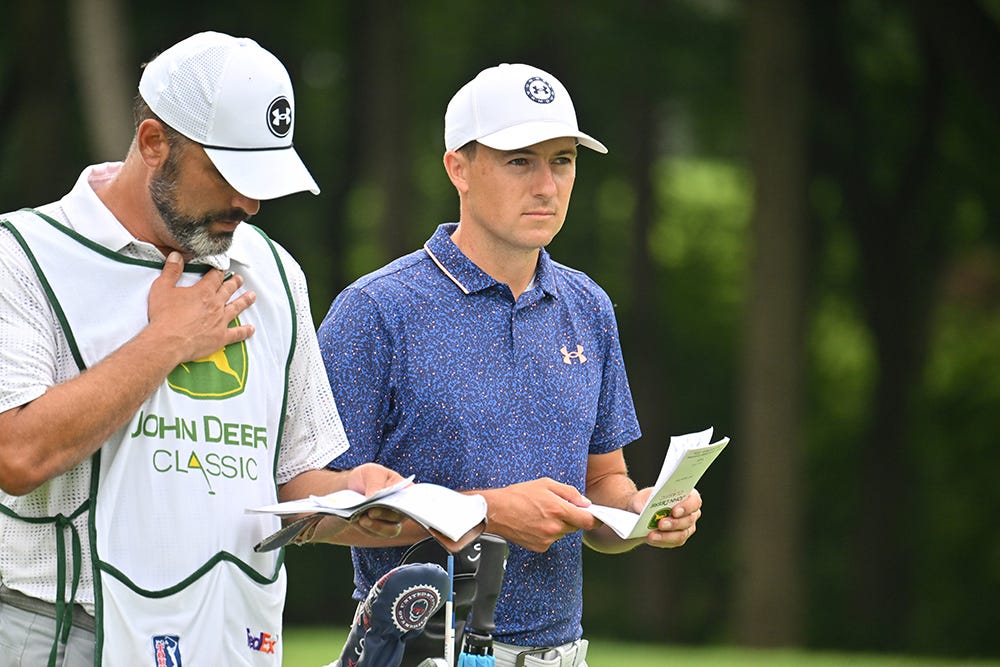
2015 John Deere champ Jordan Spieth is a marquee draw in 2026 field (Keith Gillett/Icon Sportswire via Getty Images)
‘It’s going to be just extremely competitive’
A week on from the PGA Tour’s big unveil of its future two-tiered system, there remains much to unpack. Which tournaments will be part of each series? How will players qualify for them beyond the basics announced? What unforeseen issues will arise?
One thing is clear: the competitive intensity will be increased, and there’s not going to be much ability on the Championship Series to go find your game among some easier competition if it so suits you.
Save for maybe a handful of players, the fields in the new Championship Series events in 2028 will basically be the same. They will be the top 90 finishers from the previous year plus likely various major champs, multiple winners and tournament winners who are qualified via some system to be determined.
There won’t be events with “lesser” fields to play in, as is the case this week with the John Deere Classic.
The long-time event that is played near the Quad Cities on the Illinois-Iowa border has traditionally made the most of a tough week on the calendar. For years, it was played the week prior to the Open Championship. This year, it follows the signature event Travelers Championship and precedes the Genesis Scottish Open, where numerous name players will head this weekend for a two-week links golf run through the Open Championship.
That makes it tough for organizers to get a top-notch field, but for years they’ve put on what is considered a great community event, backed by loyal players — Steve Stricker and Zach Johnson come to mind — and a title sponsor, John Deere, that is located in Silvis, Ill., where TPC John Deere plays host.
That has never stopped a smattering of established players from attending. Jordan Spieth is in the field. He won the John Deere in 2015, the week before attempting to get the third leg of the Grand Slam at St Andrews where he came up a shot short of a playoff won by John Deere regular Zach Johnson.

In the DD podcast …
Host T.J. Rives welcomes Bob Harig and Peter Kaufman, managing partner of Gordian Group, LLC
The lastest with LIV: if they reach 2027, how are they financing it?
What benefit could bankruptcy bring?
Jon Rahm’s and Bryson DeChambeau’s role in LIV’s future
Max Homa, Rickie Fowler and Keegan Bradley are a couple of others in this week’s John Deere field, something they won’t be able to play in the future if they are part of the Championship Series of events. The Deere is most likely headed toward being a Challenger Series tournament, which means it will be part of the second-tier events meant to give playing opportunities for players aspiring to move up to the bigger Championship Series the following year.
What it won’t do is allow for someone like Spieth or Fowler or Bradley — guys who played at the Travelers last week — to play in an event that is not filled with all of the big names.
“It’s going to be just extremely competitive,” Bradley said of the future tour model. “Golf has always been a sport where you have to earn what you get and, like, this is going to become even more so with that. You’re going to see players, top talent players … a lot of the Europeans that don’t get to play a full schedule out here, where they’re playing 14, 15 events. The consequences now are extreme. You’re going from playing the biggest tournaments in the world to you’re not in them, which is going to be really, really intense. I think the membership is very aware of that and golf is now even moreso becoming a result-oriented sport.
“You can’t rely on (having) a good year two years ago. You got to prove it every year, which I think is great.”
Bradley is correct in that there will be no letup in these 15 or so Championship Series events — which will be in addition to the four major championships, the Players and the postseason events.
But will a player who had a great year two years ago really be in danger of dropping out? Currently PGA Tour winners get two-year exemptions. That is one of the big decisions that will undoubtedly be a heated talking point.
Could Scottie Scheffler — as an extreme example — not be part of the Championship Series if he fails to finish among the top 90 next year? (Work with us, we realize it’s a very unlikely scenario.) Scheffler won two major championships last year. He’s won seven events in the past two seasons.
The Future Competition Committee has myriad decisions like this to make. To have it be as intense as Bradley suggested, there has to be some fear of relegation for even the best players. But where do you draw that line?
Do major winners of the past five years get a pass for any amount of time? They’ll clearly be part of the PGA Tour, but could they not be part of the top tier.
What about someone like Tiger Woods? Does his long career of excellence mean a carved-out spot in the upper tier? As it stands now, Woods is exempt into the signature events due to a special rule enacted for 80-time tour winners.
Put it this way. In the new system, if Woods wanted to play in his own Genesis Invitational at Riviera where he is the tournament host, without some sort of rule he’d be ineligible. Because there will be no sponsor invites.
Woods’ case is probably an easy one. It’s a single player that any one of those tournaments would want to have him participate. But so many other aspects to exemptions have to be determined. Medical, lifetime member, career money — not easy decisions for any of them when fields will be limited to 120 to 130 players. These
