


The Daily Drive has coverage of the U.S. Open from veteran golf insider Bob Harig all week from Shinnecock Hills. To support our work as independent golf journalists, please consider subscribing for what amounts to little more than $1 a week.
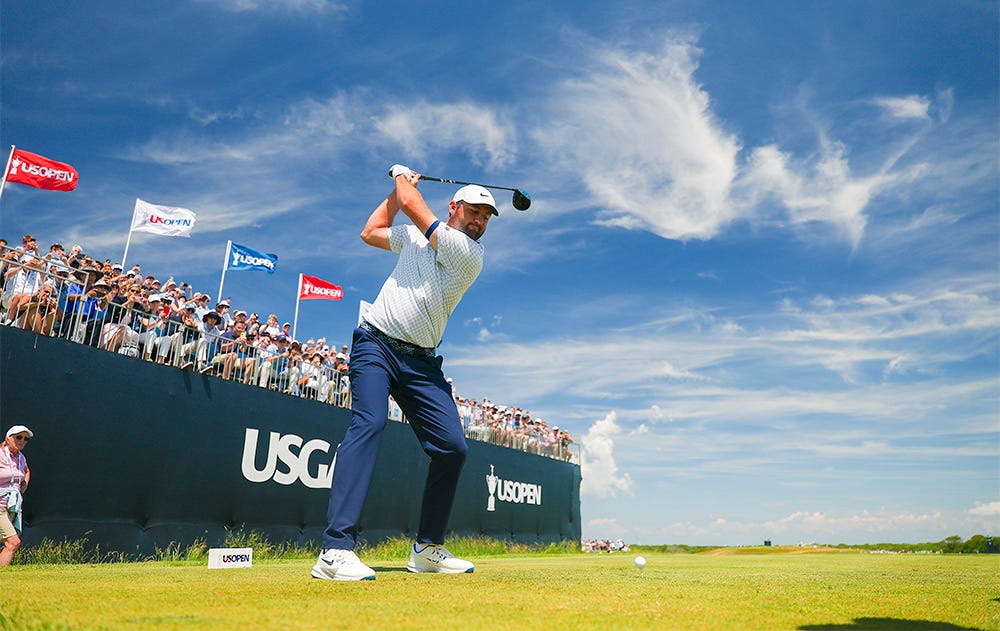
World No. 1 Scottie Scheffler tees off 12 in a practice round at Shinnecock (Dustin Satloff/USGA)
In today’s DD …
Scottie Scheffler needs to sharpen ‘dull’ form to complete career slam
The linksiness of Shinnecock will require special care with wind forecasted
Alex Miceli on the joint statement curiously rolling back the roll back
YouTube version of The Daily Drive preview podcast
Shinnecock notes courtesy Elias Sports Bureau and tee times
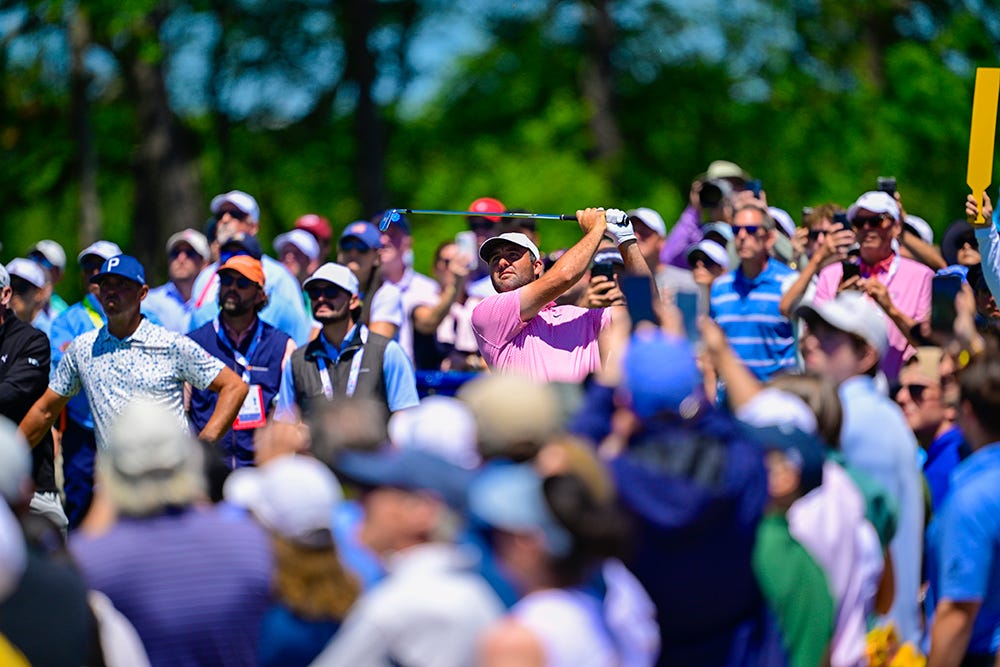
Scottie Scheffler hopes to join Tiger Woods (three times) as only OWGR No. 1s to win U.S. Open (Logan Whitton/USGA)
Scheffler: ‘I’ve just been a touch dull’
SOUTHAMPTON, N.Y. — There might not be a golf course in the United States that you truly can call a links. The term is thrown around a lot, sometimes causally to describe any course. But the true meaning is far different than just any old golf course.
A links golf course, by definition, is constructed on land that connects the sea and arable land, with a sandy base that makes for perfect draining. While the water might not always be visible, it is close by, as the Atlantic Ocean is here at Shinnecock Hills.
Is Shinnecock Hills a true links? Probably not. It looks and feels like one, however. The vast openness, the absence of trees, the wind. It packs the aura of a British or Irish links course, even if it might be missing a few qualifying ingredients.
But Shinnecock is as close as we have to a links course in the United States. It’s toward the Eastern tip of Long Island, perched high and vulnerable to wind, within a reasonable distance to the sea.
How it plays beginning Thursday morning for the 126th U.S. Open will be among the main storylines at the year’s third major championship.
“It may look like a links course. I don’t think it really plays like one,” said Scott Scheffler, the No. 1-ranked player in the world. “Links golf is really interesting in a sense of once you get the ball onto the green, most of the greens are pretty flat and they’re fairly slow compared to these greens, just because you have so many elements. Those golf courses are naturally always firmer as well.
“Links golf is one of those things where once you get the ball on the green, it’s actually fairly easy. There’s not a ton of slope on the greens. These, you can be in the middle of the green and be like, ‘wow, I don’t know how I’m going to two-putt from here.’ I think it may look like links golf but doesn’t necessarily play like it.”
That is a solid take from Scheffler, whose answers in pre-tournament news conferences can be pleasant and enlightening — a contrast to some of the terseness we see from him following rounds.
That latter is due, in part, to a slight falloff in form this year. It’s all relative, of course. And if people want to know a bit about how what Tiger Woods endured, Scheffler gives them a taste of what outsized expectations can mean.
Selected Thursday U.S. Open tee times (* means 10th tee start)
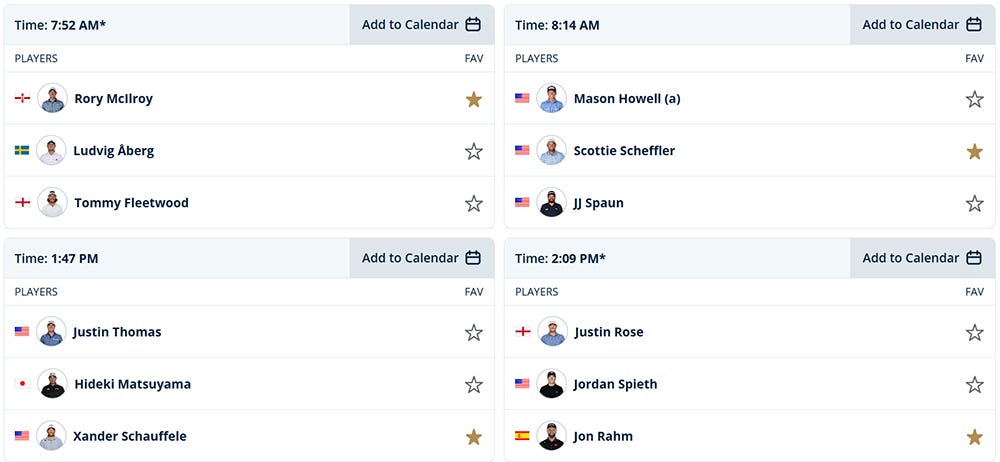
Click here for full U.S. Open tee times for first round on Thursday
He’s having the kind of year that most players would dream about — a win at the American Express Championship and six other top-four finishes. His worst result is a tie for 24th at the Arnold Palmer Invitational. He’s coming off a tie for 12th at the Memorial.
But Scheffler won six times last year, including the PGA and Open Championships. In 2024, he won eight times including the Masters, Players, Olympic gold medal and FedEx Cup. Those kinds of remarkable seasons skew the way he is looked at now.
The U.S. Open is the only major Scheffler has not won but he’s had several solid results, with four top-seven finishes in his five previous starts as a pro including runner-up in 2022 at Brookline.
“I feel like I’ve been close most of the year,” Scheffler said. “I feel like I just haven’t been as sharp as I needed to be. I think the margins in this game are so small. For me to be winning a lot of tournaments, you’ve got to just be really, really sharp.
“I feel like maybe I’ve just been a touch dull, because I think statistically I think I’m maybe leading the FedEx Cup, I think I’m leading the strokes gained statistics, so by no means is it a bad year. Is it up to the play I’ve had the previous couple of years? Probably not, but it’s not far off.
“I would say a lot of it is just the sharpness, and that can come from a variety of things. But sometimes, like, I’m either not making the momentum putt, or I make a sloppy bogey somewhere, or I hit an iron shot a touch thin instead of really solid, and all of a sudden it ends up in the bunker, and I make bogey instead of hitting a really good shot and making birdie.
“The margins are just so small I think in this game. I feel like this year I’ve been what I would describe as close.”
Scheffler’s disposition is likely to be tested in the coming days. Although he has a morning tee time on Thursday, the wind is expected to pick up while he is playing and continue into the afternoon, with gusts in the 30 mph range and possibly higher.
That forecast for wind throughout the tournament caused the USGA to reassess its green speed strategy and ratchet the speeds down. Instead of rolling in the 11-plus to 12 range on the Stimpmeter, the speeds will be in the 10.5 area, which is a drastic difference from U.S. Opens in recent decades — especially at Shinnecock.
John Bodenhamer, the USGA’s chief championships officer, said during a Wednesday news conference that his research of course-set up notes suggested that green speeds have not been measured under 11 at the U.S. Open since 1995 — a tournament also played at Shinnecock.
“You might see a little bit softer conditions, but this place dries down quickly,” Bodenhamer said. “We think we just have the right plan to get through the day. High winds, we’re just going to be very careful.”
Given some of the high-profile and highly-criticized course set-up issues of the past two U.S. Opens at Shinnecock, playing it safe appears prudent.
“It’s a very, very fine line,” said Rory McIlroy, who won the 2011 U.S. Open at Congressional. “I think good shots getting rewarded and bad shots getting punished. We’re expecting wind. As long as they don’t get the greens too fast, I don’t think there will be an issue.”
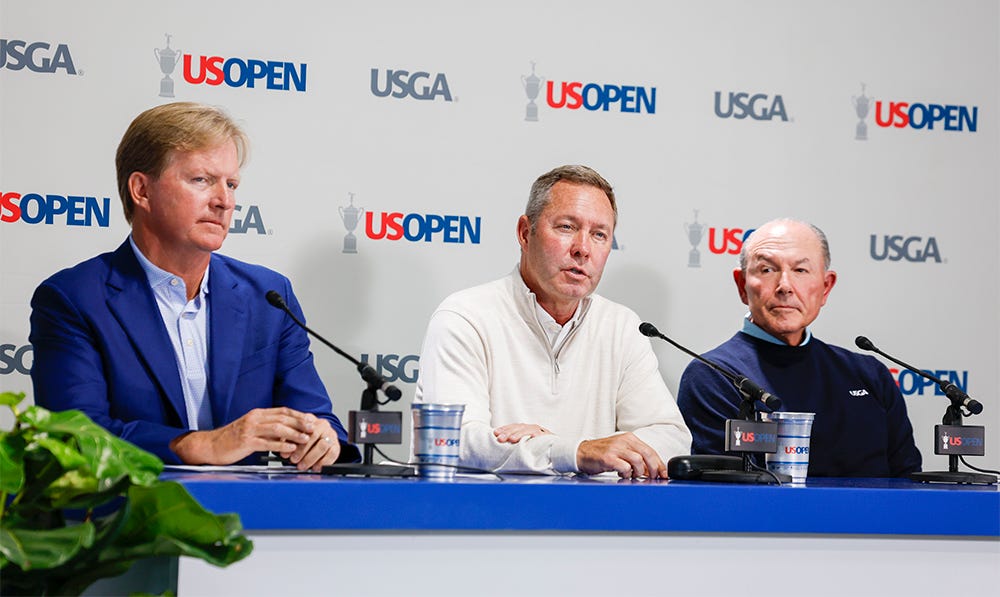
From left: USGA president Kevin Hammer, CEO Mike Whan and chief championship officer John Bodenhamer discuss the pressing issues ahead of the 126th U/S. Open (Chris Keane/USGA)
Rollback walk back? ‘We started talking’
By Alex Miceli
Do you remember 2018?
It was a time when the first-world rankings of the year had Dustin Johnson as the top-ranked player in the world and Pat Perez ranked 16th, above Tyrrell Hatton, Tommy Fleetwood, Xander Schauffele and Matt Fitzpatrick.
How funny it seems now, Perez at No. 16 in the world.
Just over eight years later, he has been banished until January of 2027, when he can play on the PGA Tour Champions. The thought of him ever being ranked in the top 20 in the world is a fleeting one.
Around the same time as Johnson’s top position in the world, the R&A and USGA decided, in their infinite wisdom, that distance was an issue. And the best way to address the distance problem, they believed, was to roll back the golf ball.
While the world rankings have changed dramatically since early 2018, the ball debate is still on the tip of everyone’s tongue. But maybe that has changed as well.
On Wednesday — just 30 minutes before the USGA press conference with CEO Mike Whan, president Kevin Hammer and chief championships officer John Bodenhamer — a joint statement by the USGA, R&A, PGA Tour and DP World Tour was released that put a temporary halt to the golf ball rollback in 2028 and extended the period to 2030.
