

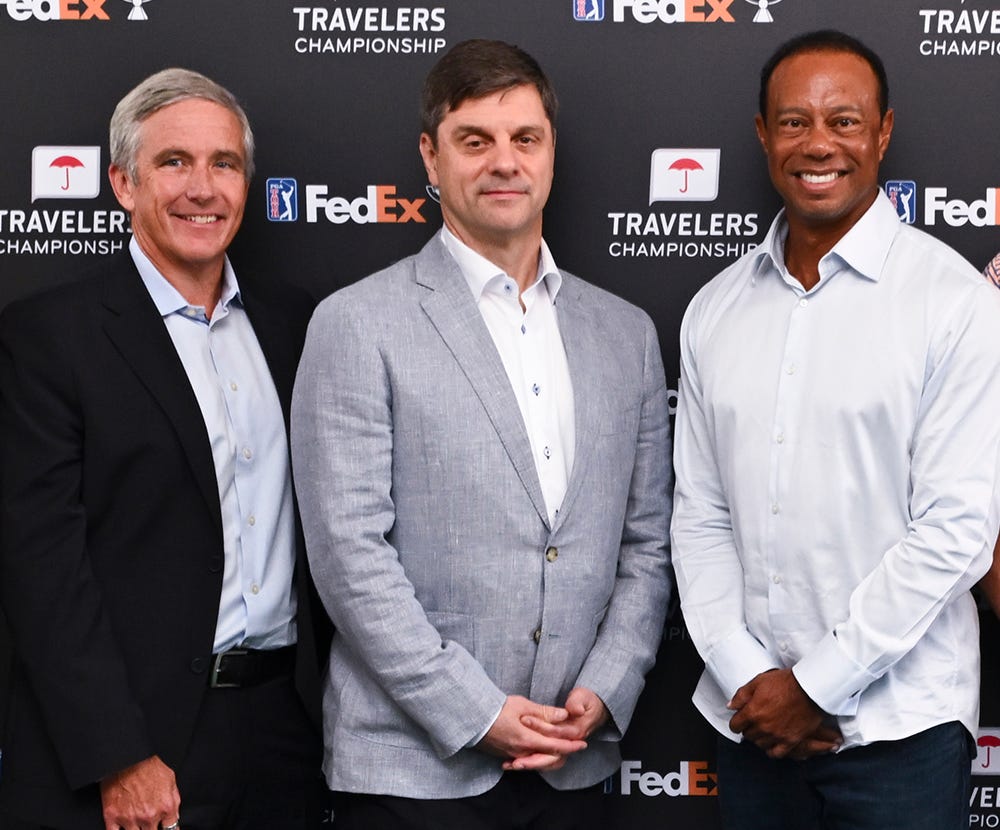
From left: Jay Monahan, Brian Rolapp and Tiger Woods (Tracy Wilcox/PGA Tour via Getty Images)
The PGA Tour is undergoing a metamorphosis. It’s future — to say the least — is on the murky side.
What began in 1968, following a split from the PGA of America, the PGA Tour has been the professional arm of golf in the United States.
Over time, it’s gained significant power and, for most of its history, has had its own way, big-footing players, agents, tournaments and other tours worldwide.
Under its last three commissioners (Deane Beman, Tim Finchem and Jay Monahan) the goal was simple — control the narrative and don’t back down from anyone.
But since the inception of LIV Golf in 2021 as a competitive rival, the tour has been in a battle for the hearts and minds of golf fans. And, in some cases, even its own players.
The casualties have included a quiet player revolt that ultimately led to Monahan leaving his job, a new investment entity (Strategic Sports Group) pouring $1.5 billion into a for-profit tour enterprise, and a new CEO hired from the NFL, Brian Rolapp.
Rolapp has been close to the vest on his thoughts and plans, though he says “I will do whatever makes the PGA Tour stronger.”
At the CNBC CEO Forum in Palm Beach Gardens, Fla., last week, Rolapp provided a vague road map for the PGA Tour’s future that won’t be dependent on just a few sacred stars.
“Any sport worth its salt says, if this competition only works if there are a couple people in it, it’s not a sport, it’s a circus,” Rolapp said.
“Every sport has stars, but what really makes sports work is really the middle class,. So, in my old job, sure, we put the Kansas City Chiefs on primetime as much as we can, but that’s not why the NFL was so successful. It was because when the Bengals are good, you watch, and when the Lions are good, you watch. The middle class matters. You cannot build a lifelong sport that outlives your stars if you don’t build a system that works beyond your stars.”
But oddly, it’s a future may be based on less is more.
The primary goal is slimming down the main schedule to less than 30 events and squeezing the season into a smaller calendar window that would start after the Super Bowl and end before the beginning of the NFL season.
“Competing with football in this country for media dollars and attention is a really hard thing to do,” Rolapp said.
“The majority of golf is played in the summer and gets people’s attention, so looking at schedules that optimize that calendar is certainly something we talk about.”
So, Rolapp, the former No. 2 at the NFL, clearly knows better than anyone how big American professional football is in the marketplace.
Yet, Rolapp is using the NFL playbook for guidance. There is a flaw in the strategy, however, of a playbook with three guiding principles: competitive parity, simplicity and scarcity.
The PGA Tour, like the NFL, has competitive parity in its meritocracy, which, according to Rolapp, is the hardest to gain.
Unfortunately, simplicity has been an issue throughout the FedEx Cup era, with its nonsensical use of the term “playoff” always a misnomer and a revolving door of changes to how the season ends.
“Part of professional golf’s issue is it has grown up as a series of events that happen to be on television, as opposed to, how do you actually take those events, make them meaningful in their own right, but cobble them together in a competitive model, including with a postseason that you would all understand whether you’re a golf fan or a sports fan,” Rolapp said.
Looking ahead, professional golf possibly can’t have even an ounce of scarcity.
LIV Golf has enough money from the Saudi sovereign wealth Public Investment Fund to compete on a global scale. Add in the DP World Tour, LPGA, Ladies European Tour, Asian Tour and many other smaller worldwide tours — not to mention developmental and senior circuits — and it’s clear to see that scarcity is not easily obtained.
Ultimately, the future seems muddied for a leaner PGA Tour, and one in which it will always struggle to match the popularity it earned during the Tiger Woods heyday.
Yet that same Woods — who is the top player and chairman of Rolapp’s newly created “future competition committee” — sees a path to the future.
“There’s going to be some eggs that are spilled and crushed and broken, but I think that in the end we’re going to have a product that is far better than what we have now for everyone involved,” Woods said on Tuesday at his Hero World Challenge event in the Bahamas.
Neither Rolapp nor Woods has articulated what they consider “better.” But it’s their ball now to do it their way.
“So, those are the questions we’re asking how to make bigger and better events, how to put them in the calendar where fans will watch more and how to put it in a competitive model that not only golf fans, but sports fans will embrace,” Rolapp said. “Those are all the things we’re discussing. Nothing’s been decided, but that’s the committee’s job.“
As Woods said, they might break a few eggs getting there, so let’s see what the next year brings.
