


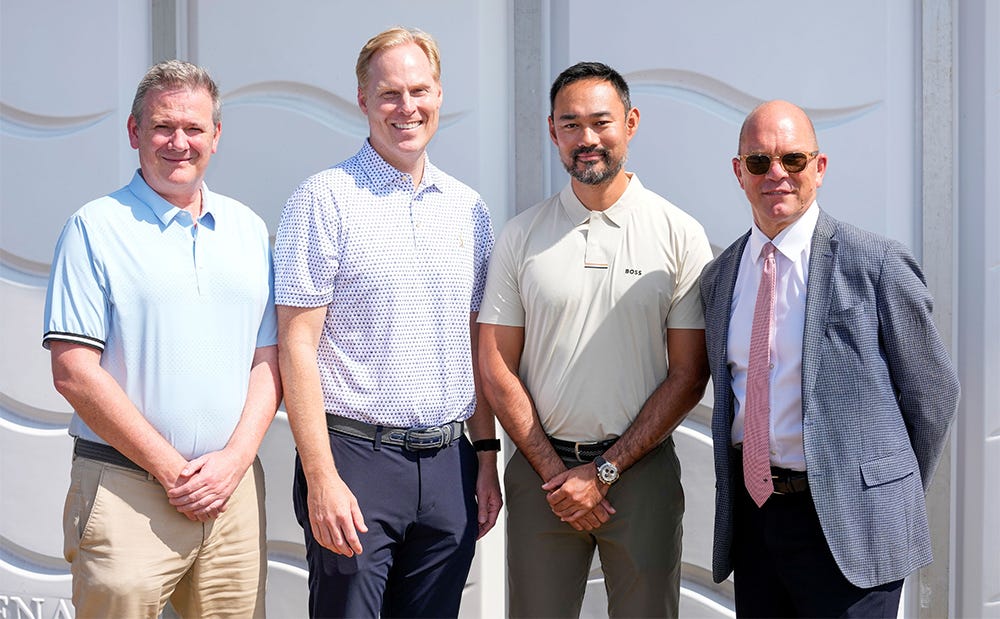
(From left) Ben Cowen, DPWT chief tournament and operations officer; Christian Hardy, PGA Tour senior VP, international; Cho Minn Thant, Asian Tour commissioner & CEO; Guy Kinnings, European Tour Group CEO (Asian Tour)
LIV Golf 2.0 might find investors willing to back the league. It could find big-money vanity owners who are willing to buy team franchises. It very well could survive as a leaner, meaner version of itself, with a condensed schedule, smaller purses and a more modest buildout.
But even if all of that pans out, LIV Golf will have a very difficult time overcoming the Tuesday announcement that the Asian Tour is partnering with the DP World Tour and the PGA Tour after being affiliated with LIV since 2022.
Add in co-sanctioning deals with national opens like the previously anounced Australian and now some Asian Tour events — which was said to be a part of LIV’s business pitch going forward — and the hurdles are building up against LIV’s future viability.
The affiliate deal with the Asian Tour isn’t a financial blow to LIV like the Saudi Arabian Public Investment Fund withdrawal, but it is a devastating one nonetheless.


Without that pathway system for new players to qualify to play LIV and without the Asian Tour’s International Series as a place for LIV players to compete outside of the league, it is very difficult to envision a scenario where the beleaguered league can survive, let alone thrive.
And its hard-sought quest for Official World Golf Ranking accreditation could be in serious jeopardy — perhaps the biggest and most consequential fallout from this development.
As LIV prepares to play this week in the UK for its first event in seven weeks, the DP World Tour announced the formal arrangement that will see Asian Tour players earn spots on the DP World Tour as well as its developmental circuit, the HotelPlanner Tour. Some co-sanctioning of national opens on the Asian Tour is also part of the plan.
The new deal was also touted by the PGA Tour, which has a “strategic alliance” with the DP World Tour that sends its top 10 players not otherwise exempt to the PGA Tour each year.
Golf Digest first reported the news and quoted Asian Tour CEO Cho Minn Thant who said the uncertainty over LIV’s future in the wake of the PIF’s announced departure earlier this year caused the circuit to change course and seek more stable partnership.
All three tours officially announced the alliance on Tuesday:
The Asian Tour, DP World Tour and PGA Tour today announced a partnership through until at least 2029, marking a new chapter for global golf.
Effective immediately, the PGA Tour and DP World Tour – through their own existing Strategic Alliance – will partner with the Asian Tour to help provide commercial and playing opportunities, also establishing pathways for the leading Asian Tour members, with playing rights starting from the 2027 DP World Tour season.
The DP World Tour will also return to co-sanctioning select tournaments with the Asian Tour from 2027. Full details of those events will be outlined when the DP World Tour’s schedule for next season is announced later this year.
“I think the timing is just right now, it’s all about timing,” Thant said. “We’d kept in touch (with the DP World Tour) over all these years. Six years ago, it was right for us to do a partnership with LIV Golf, but given the circumstances now, we’ve had to look at other options.
“Pathways to different tours are very important for our members. We’ve got the Asian Development Tour, which feeds into the main tour. We’ve got several co-sanctions with other tours as well. I think over the last five years, our membership has become a little bit more cosmopolitan. There are a lot more foreigners playing in Asia now and they enjoy coming to Asia, but we also need a pathways to progress onto bigger tours.”
The DP World Tour and Asian Tour previously had a strategic alliance from 2016 to 2021, formalizing a relationship which originated in February 1999 when the Malaysian Open became the first tournament to be co-sanctioned by the two tours.
The Asian Tour was hurting financially during and after the COVID pandemic and LIV Golf came to the rescue with all of its riches and offered a lucrative partnership prior to even launching. In 2021, before LIV had signed a single player, the PIF announced a 10-year deal with the Asian Tour that would see it fund a series of elevated events within the circuit called the International Series. The 10-year deal was said to be worth some $300 million.
Those events typically had $2 million to $2.5 million purses — double the purses of Korn Ferry Tour events and not far behind some DP World Tour events — and served as a qualifying system for LIV, although it was woefully underutilized.
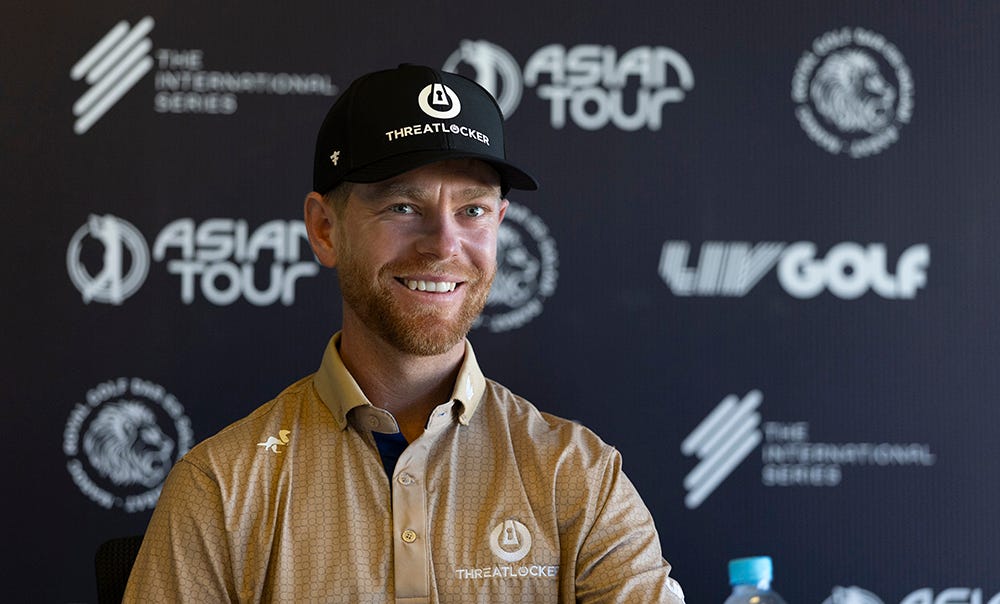
Scott Vincent earned a place at LIV Golf by winning 2025 International Series (Ian Walton/Asian Tour)
Perhaps more important, it became a refuge for LIV players who were banned from the PGA Tour and all of its affiliates, offering a place to play outside of LIV while earning some world ranking points. Some LIV players were contracted to play in International Series events, giving the tournaments bigger names and a credibility boost.
Last year, the top two finishers on the International Series — Scott Vincent and Yosuke Asaji — earned spots on LIV Golf this year, along with three players from its promotions tournament (Anthony Kim, Richard Lee and Bjorn Hellgren).
LIV CEO Scott O’Neil, who reportedly did not know about this new arrangement until Monday before the announcement, has actively been pitching investors on a plan that would include national opens as part of an Asian Tour package. This would appear to be off the table now, and leaves LIV players with no easy access to the Asian Tour tournaments to which it had more or less been gifted spots.
Although LIV Golf suffered through various missteps and changes from the beginning, it got right from the outset the idea of affiliating with an established tour. The Asian Tour, in essence, sponsored LIV Golf for OWGR inclusion, as is required.


Also required for OWGR inclusion is having movement from one eligible golf tour to another or vice versa. It became the hot topic in LIV’s OWGR application, as the amount of relegation and promotion was not deemed to be sufficient.
O’Neil resubmitted LIV’s OWGR bid last June and finally the league was approved — with restrictions — in February, with LIV players earning points for top-10 finishes in 2026.
It wasn’t as much as the league had hoped for, but it was another point of validation along with both the U.S. Open and Open Championship recognizing points leaders on LIV for exemption categories. The belief was in a LIV 2.0, the league would lean more into its affiliation with the Asian Tour, creating a viable place to develop talent while partnering with some national opens, such as the Hong Kong Open.
All of this is amid various other issues, including a lawsuit involving unpaid invoices by a company called Mobii Systems, which produced LIV’s “Any Shot, Any Time” graphics during broadcasts and said the league breached an agreement, suing for more than $1 million in unpaid invoices.
LIV is also being sued by World Golf Group and the Premier Golf League, which had the original idea for a rival global golf circuit and says LIV stole many of its ideas.
All of that is bad enough. Lawsuits, a lack of funding, an uncertain plan for the future.
But there can almost be no future without a corresponding pathway system, perhaps the biggest blow of all to LIV Golf’s plans.